
Efflorescence Brick Removal: A Safe Step-by-Step Guide
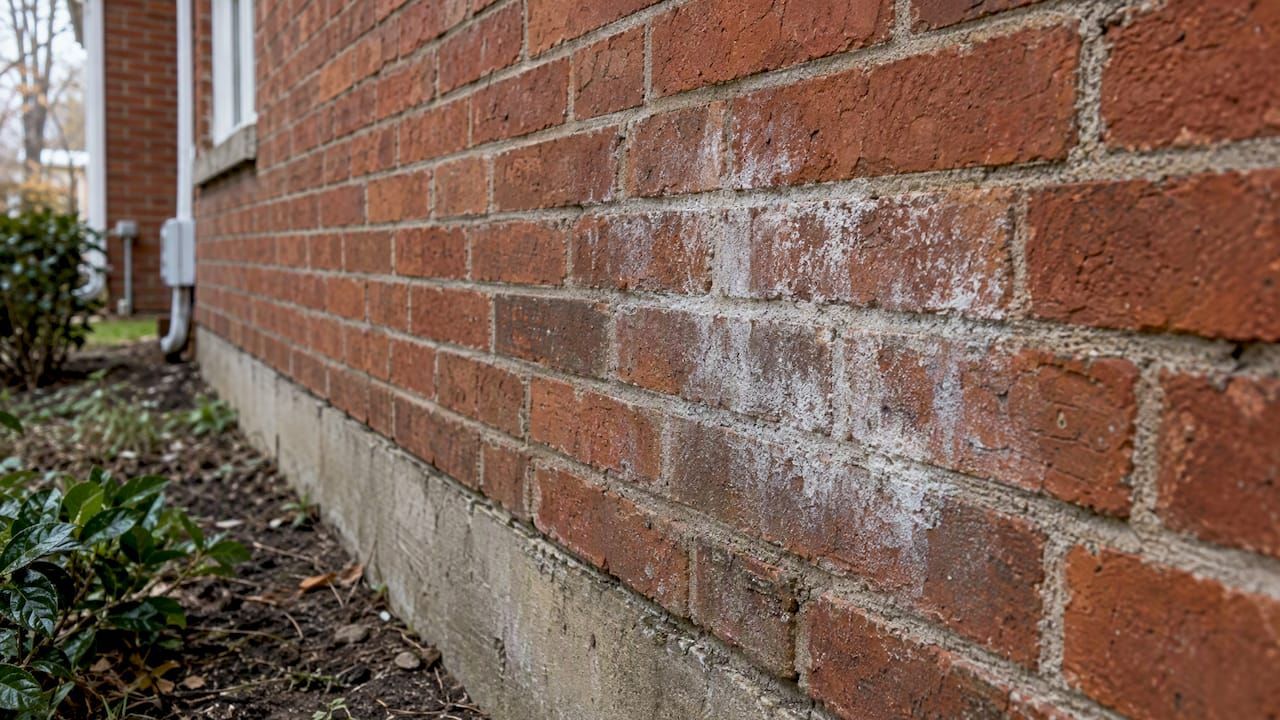
The white, powdery film on your brick is almost always a salt deposit, and the safest way to remove it is to let the wall dry, brush it off with a stiff dry brush, and fix whatever is feeding it water. Cleaning only treats the symptom. If moisture keeps reaching the brick, the salts come back. This guide covers how to confirm what you are looking at, which removal method to use for light and heavy deposits, what to keep away from your mortar, and how to keep the stain from returning.
TL;DR
- Confirm it is efflorescence first: a dry, powdery white deposit that brushes off. Lime run and calcium carbonate scum look similar but need different treatment.
- Start with a stiff, dry fiber brush on a dry wall. Most light to moderate deposits come off this way, per the Brick Industry Association.
- Skip muriatic acid and aggressive pressure washing. Both can leave the brick and mortar more porous and more likely to stain again.
- For heavy deposits, use a buffered masonry cleaner and follow the label exactly. For chronic cases, find and stop the water source.
- Historic brick needs a lighter touch. Some deposits are part of the material.
Table of Contents
- What efflorescence is and why it shows up on brick
- Is it really efflorescence? Check before you clean
- Step 1: Find the water before you clean
- Step 2: Let the wall dry
- Step 3: Dry brushing for light to moderate deposits
- Step 4: A mild acidic rinse, used carefully
- Step 5: Buffered masonry cleaners for heavy deposits
- What to avoid
- Chronic efflorescence: when brushing is not enough
- Historic brick needs a different approach
- How to keep efflorescence from coming back
- Our perspective: treat the surface gently and the cause seriously
- Brick efflorescence cleaner or something else: choosing for your surface
- Protecting the hard surfaces around your brick
- Where Oceancare fits in
- FAQ
- Sources
What efflorescence is and why it shows up on brick
Efflorescence forms when water moves through masonry, dissolves the soluble salts inside it, and carries them to the surface. The water evaporates and the salts stay behind as a white crust or fuzzy powder. The Brick Industry Association treats it as a common stain on brickwork that can be removed with the right method. It needs three things at once: soluble salts, water, and a path for the water to reach the surface. Remove any one and it stops.
On a new building it is often called new building bloom. It appears in the first months as the excess moisture built into the materials dries out, and it frequently fades by itself with weathering. The Concrete Masonry & Hardscapes Association notes that efflorescence is mainly an appearance problem and does not affect structural performance.
That last point deserves a caveat. A one-time bloom on a new wall is normal. Deposits that return every season, or that sit at a consistent height, are telling you something about water. We cover that below.
Is it really efflorescence? Check before you clean
Most cleaning mistakes start with a misdiagnosis. The Brick Industry Association points out that efflorescence is often confused with other white stains, especially lime run and calcium carbonate scum. The treatments differ, and acid applied to lime run can make it worse by creating a harder surface layer, according to the BIA cleaning guide.
Use these quick checks:
| Test | Efflorescence | Lime run or carbonate scum |
|---|---|---|
| Texture | Powdery, feathery or crystalline, often brushes off dry | Hard, crusty or streaked, does not brush off |
| Where it appears | Face of brick or mortar, often in patches after wet weather | Runs down from a joint, crack or ledge in streaks |
| Dry brush test | Largely lifts away | Barely changes |
| Reaction to water | Salts dissolve in a damp cloth and reappear as the wall dries | Stays put |
If a dry brush removes most of the white, you have efflorescence. If it stays put like a hard crust, stop and look at the BIA stain identification note, or ask a masonry contractor before using any chemical on it.
One more look is worthwhile. Note where the white appears. Deposits under a window sill, below a missing cap, along the base of a wall or at a consistent height above the ground say a lot about where the water is coming from.
Step 1: Find the water before you clean
Experts quoted by the Brick Industry Association put it plainly: cleaning without stopping the water penetration only resets the clock until the next batch of salts appears. Spend ten minutes on the wall before you pick up a brush.
Common sources of water in brick walls include:
- Missing, cracked or poorly lapped flashing above windows, doors and at the base of a wall
- Gutters and downspouts that overflow or discharge against the wall
- Cracked or eroded mortar joints
- Soil, mulch or planters piled up against the brick
- Sprinklers that spray the wall
- Rising damp from the ground, which tends to leave white deposits at a fairly even height
- Open tops of parapets, chimneys and garden walls with no cap or coping
The National Park Service describes how persistent moisture in masonry can lead to long-term decay, including spalling, which is when the face of the brick flakes off. That is the real reason to treat recurring efflorescence as a warning rather than just a cosmetic issue.
If sprinkler overspray or hard water also leaves spots on nearby glass or solar panels, this guide on hard water spots on solar panels explains when a simple rinse is enough and when to call a professional. Redirecting the sprinkler heads solves both problems at once.
Step 2: Let the wall dry
Timing matters more than the product. The BIA advises that brick needs to be dry for cleaning to stop salt migration, and that heavy water-based cleaning should be avoided in cold or humid conditions. If the wall is saturated, any water you add just dissolves more salt and draws it to the surface when it dries.
Wait for a stretch of dry weather. In many parts of the US, late spring through early fall gives the best window, while in cold climates you should avoid wetting brick when freezing temperatures are expected, since trapped water can damage it.
Step 3: Dry brushing for light to moderate deposits
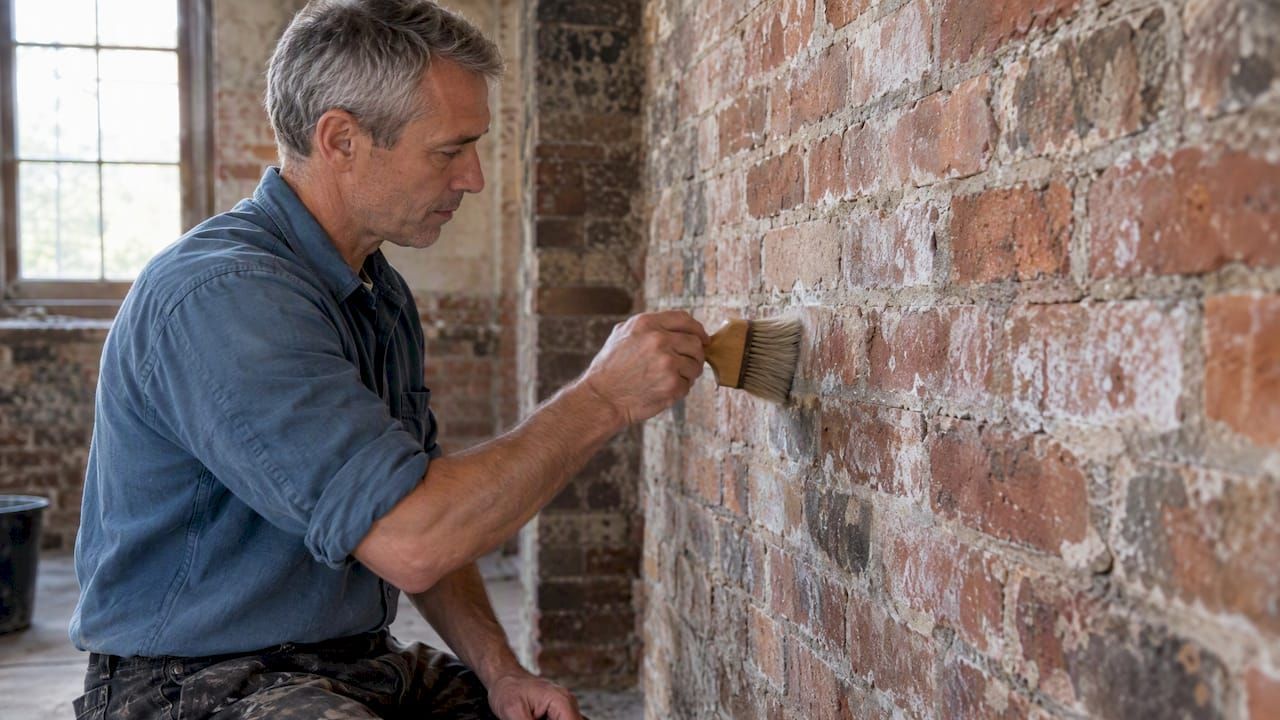
The Brick Industry Association names dry brushing with a stiff fiber brush, followed by brushing with clean water, as the most effective method for light to moderate efflorescence. It is also the cheapest and the least risky.
- Put on safety glasses and a dust mask. The dust is mostly mineral salts, and you do not want it in your eyes or lungs.
- Lay a drop cloth or tarp at the base of the wall and over any plants.
- Brush with a stiff fiber (nylon or natural bristle) brush, not wire. Wire bristles leave metal particles that rust and stain brick.
- Work in small sections from the top down so the loosened powder falls onto uncleaned areas.
- Collect the powder and dispose of it. Do not wash it into planting beds or sweep it into the soil along the wall.
- If a faint film remains, use a damp brush with a minimal amount of clean water, then let the wall dry fully.
On flat surfaces some manufacturers also suggest agitating with a white nylon pad while dry. Test on a small area first.
Repeat after a few weeks of dry weather. New building bloom often needs two or three rounds before it stops reappearing.
Step 4: A mild acidic rinse, used carefully
Some homeowners reach for white vinegar. Angi's brick guide describes spraying diluted vinegar, letting it sit for about 10 to 15 minutes, then scrubbing gently with a dry, stiff brush, and notes that heavy efflorescence may need more than vinegar.
Be careful. Vinegar is an acid, and acids react with the lime in mortar. If you try it, pre-wet the surrounding area lightly, work on a small, hidden test patch, keep the contact time short, and rinse well with clean water. Red brick and mortar can be visibly lightened by overdoing it. Painted, glazed or historic brick should not be treated this way at all.
Step 5: Buffered masonry cleaners for heavy deposits
When the deposit is thick, dry brushing cannot keep up. The BIA says to use a proprietary masonry cleaner and follow the manufacturer's instructions strictly. The PROSOCO masonry guide notes that improper use of traditional acidic cleaners can etch the surface and damage mortar, making the brick more porous and likelier to stain again, and that buffered masonry cleaners are designed to reduce that cycle.
How to choose and use one:
- Pick a product made for the substrate. Clay brick, concrete brick, manufactured stone and natural stone are not interchangeable. The label must name your material.
- Prefer buffered, detergent-based formulas over straight acid. Check the label for the pH range and the dilution.
- Test first on a spot you can live with, let it dry fully, and judge the result in daylight.
- Pre-wet the wall if the label says so, so that the cleaner does not sink deep into dry brick. Always follow the label for how long to wait and how to rinse.
- Rinse thoroughly with low-pressure water, then let the wall dry for several days.
- Protect plants, metal, glass and adjacent surfaces, and wear chemical-resistant gloves and eye protection.
Acid runoff can discolor nearby stone, damage lawn and harm vegetation, so follow your local rules on wastewater, especially on commercial or multifamily properties.
What to avoid
Muriatic acid on clay brick
The BIA technical note on stains warns against muriatic acid on brick. Its strength is unpredictable, impurities can cause permanent stains, and it etches mortar joints, which lets in more water and leads to more efflorescence. A buffered masonry cleaner is the safer choice, and in many cases a brush is all you need. If you hire a contractor, ask what product they plan to use and why.
High-pressure washing
The BIA discourages pressure washing for efflorescence. Forcing water into the wall can push moisture deeper and bring more salts out as it dries. The Resene guide that ranks in Google reaches a similar conclusion: waterblasting can lead to the efflorescence continuing. If you must rinse, use low pressure and a minimum of water.
Sealing over damp brick
A sealer applied over a wall that still holds moisture and salts can trap them. A film-forming product may blister or turn cloudy. If you plan to seal, make sure the wall has dried completely and the salts have been removed first, and choose a breathable, penetrating product designed for masonry.
Wire brushes and harsh scrubbing
Wire leaves rust-prone particles in the pores of the brick, and hard scrubbing wears the fired face of the brick. Stiff fiber bristles do the job.
Chronic efflorescence: when brushing is not enough
If the deposits reappear after you have fixed obvious water sources and cleaned them off, salts may be deep within the wall. Conservators use desalination, typically a clay poultice applied to a pre-wetted wall that draws soluble salts out as it dries. The GSA guidance on removing soluble salts from brick and stone describes the approach. It takes weeks and careful execution, so it is a job for a masonry restoration contractor rather than a weekend project.
Call a professional if you see any of the following:
- White deposits at a consistent height, which can point to rising damp
- Flaking, crumbling or peeling brick faces (spalling)
- Mortar that is sandy, soft or missing
- Staining inside the house on the same wall
- Efflorescence that returns within weeks of cleaning
A structural engineer or a licensed masonry contractor can assess whether the wall has a flashing, drainage or foundation problem.
Historic brick needs a different approach
National Park Service preservation guidance cautions that historic masonry calls for special care. Some deposits are part of the material, and forcing complete removal with aggressive cleaning can cause lasting damage to the surface. The NPS maintenance guide Keeping It Clean is a good starting point. If your home is older, listed on a historic register or in a historic district, the gentlest method that works is the right one, and a preservation mason should confirm before anything stronger than a brush and water touches the wall.
How to keep efflorescence from coming back
Prevention is all about keeping water out and letting the wall dry. The checklist:
- Fix flashing, caps and copings so water sheds away from the wall.
- Repair cracked joints by repointing with mortar matched to the original.
- Direct gutters and downspouts away from the foundation.
- Lower soil and mulch levels so they sit well below the brick.
- Adjust irrigation so it never hits the wall.
- Allow drying time before sealing, and use a breathable penetrating product if you seal.
- Check back after wet seasons. Catching a faint bloom early takes one minute with a brush.
The BIA technical note on causes and prevention includes a troubleshooting list that links specific patterns to likely causes, which is handy when you cannot work out where the water is coming from.
Our perspective: treat the surface gently and the cause seriously
We sell cleaners and sealers for pool tile, natural stone, grout and other hard surfaces, so we see efflorescence all the time: on pavers, pool coping, stone veneer, grout lines and tile. The pattern is the same across all of them. People reach for the strongest acid in the garage, the surface looks great for a week, and then the white comes back, often with a rougher, thirstier surface than before.
Our view is simple. First, find the water. Second, use the mildest method that works, which is usually a dry brush. Third, if a cleaner is needed, choose one made for the material and avoid unbuffered acid on anything porous. That is the reasoning behind how we formulate: plant-based, biodegradable, low-VOC and acid-free products that are meant to be safe for sensitive surfaces and for the people and plants around them.
We will also be straight about scope. For a clay brick wall, the first line of defense is the method above, and any product, ours included, should be checked against the label for your specific material before it goes on the wall. Where our range shines is on the hard surfaces around the brick: pavers, natural stone, grout, tile and pool surfaces, where efflorescence and calcium deposits are a constant. Our guides on removing efflorescence from pavers and what tile efflorescence is and how to fix it apply the same principles to those surfaces.
Brick efflorescence cleaner or something else: choosing for your surface
Brick is rarely alone. Patios, walkways, retaining walls, fireplace surrounds, pool decks and grout lines often sit side by side, and each reacts differently to a cleaner. Use this as a quick guide:
| Surface | Typical first step | Notes |
|---|---|---|
| Clay brick wall | Dry stiff-brush, then clean water | Avoid muriatic acid and high pressure |
| Concrete pavers | Dry brush, then a cleaner made for pavers | See our paver efflorescence steps |
| Natural stone | Acid-free stone cleaner | Acids can etch calcareous stone such as limestone, travertine and marble |
| Tile and grout | Gentle, non-acidic deep clean | See our grout cleaning without harsh acids |
| Pool tile line | Calcium-specific cleaner | Waterline scale is usually calcium, not efflorescence |
Two related problems often get mistaken for efflorescence. Calcium buildup on stone, which we cover in removing calcium buildup without acid or damage, and sealer residue or haze left after a sealing job, covered in removing sealer residue from tile. A quick dry-brush test tells you which one you have.
Protecting the hard surfaces around your brick
Once the white is gone, protecting adjoining surfaces keeps them easier to maintain. If you have natural stone or grout beside the brick, a properly chosen sealer slows water and stain absorption without changing how the surface looks. Read our guide to choosing the right stone sealer and common problems with stone sealers before you buy, since a wrong sealer or a poor application is a common cause of cloudy surfaces and trapped moisture.
Where Oceancare fits in
If you maintain pools, patios, stone floors or tiled areas, our range covers the routine cleaning and the protection. Browse our stone and grout sealers for protecting stone and grout, our home essential cleaners for everyday surfaces, and our pool tile maintenance products for waterline and tile care. All are formulated to be eco-friendly, biodegradable and low-VOC. Always check the product page for the surfaces it is intended for before you apply it.
FAQ
What breaks down efflorescence?
Water dissolves it, which is why it can reappear if the wall stays damp. Dry brushing removes most of it physically, and a buffered masonry cleaner dissolves heavier deposits. Over time, weather also washes new building bloom away on its own.
Does efflorescence mean water damage?
Not necessarily. A light bloom on new brick is common and usually fades. But deposits that keep returning, or that appear alongside flaking brick, soft mortar or interior stains, point to ongoing moisture that should be traced and repaired. See the checklist above and consider a masonry contractor.
Can I use vinegar on brick efflorescence?
Diluted white vinegar is a common home method, and it can work on light deposits. Because it is an acid, it can dull mortar, so test a hidden spot, keep contact short and rinse well. Do not use it on historic, painted or glazed brick.
How do I clean a red brick wall with white stains?
First check whether the stain is efflorescence with a dry brush test. If it is, let the wall dry, brush it with a stiff fiber brush and remove the dust. If the stain is hard and crusty or does not brush off, it may be lime run, which needs a different treatment, so consult the BIA stain guide or a mason.
Will sealing brick stop efflorescence?
Sealing does not fix a wall that is already taking on water, and it can trap salts if applied to damp brick. Repair the water source, let the wall dry and remove existing salts first. If you then seal, use a breathable penetrating product made for masonry.
Sources
- Brick Industry Association: Cleaning Brickwork
- Brick Industry Association: Efflorescence, Causes and Prevention
- Brick Industry Association: Stains, Identification and Prevention
- Concrete Masonry & Hardscapes Association: Control and Removal of Efflorescence
- National Park Service: This Masonry Is for the Bees
- National Park Service: Keeping It Clean
- GSA: Removing Soluble Salts From Within Brick and Stone Masonry
- PROSOCO: Brick efflorescence removal and prevention tips
- Angi: How to Remove Efflorescence From Brick

