
Rust Stains on Pavers: Find the Source, Then Lift Them Safely
Rust stains on pavers are almost always removable if you work out what caused them first and then match the cleaner to the paver material. Surface rust from a chair leg or fertilizer needs different chemistry than iron naturally present in the stone, and a harsh acid used on the wrong paver can etch it and leave a mark worse than the one you started with. This guide walks you through diagnosing the stain, testing, removing it, handling deep stains with a poultice, and keeping it from coming back.
TL;DR
- Identify the source before you clean: metal furniture, planters, fertilizer, irrigation water or iron within the stone itself.
- Wet the paver with clear water first and test any product in a hidden spot. Dry, porous stone pulls cleaner deep into the pores.
- Avoid muriatic (hydrochloric) and brick acid on limestone, marble, travertine and polished pavers. They can etch and permanently discolor the surface.
- Deep stains usually need a poultice left in place for 24 to 48 hours, not a quick scrub.
- Once clean, seal the pavers and fix the source so the stain does not return.
Table of Contents
- Why pavers get rust stains
- Work out what you are dealing with
- Match the cleaner to the paver
- How to remove a fresh or light rust stain
- When the stain is deep: poulticing
- Is it rust or something else?
- Our perspective: gentle chemistry first
- Seal pavers after cleaning to stop the next stain
- Where our products fit
- When to call a professional
- FAQ
- Sources
Why pavers get rust stains
Rust is iron reacting with moisture and oxygen. When the metal corrodes, tiny iron particles migrate into the porous face of the paver and leave an orange or brown mark. Tile & Stone Journal notes that rust usually shows as an orange stain on the face of the paver, but the origin can differ, and not knowing the origin is what makes marks hard to remove.
The usual suspects around a US yard:
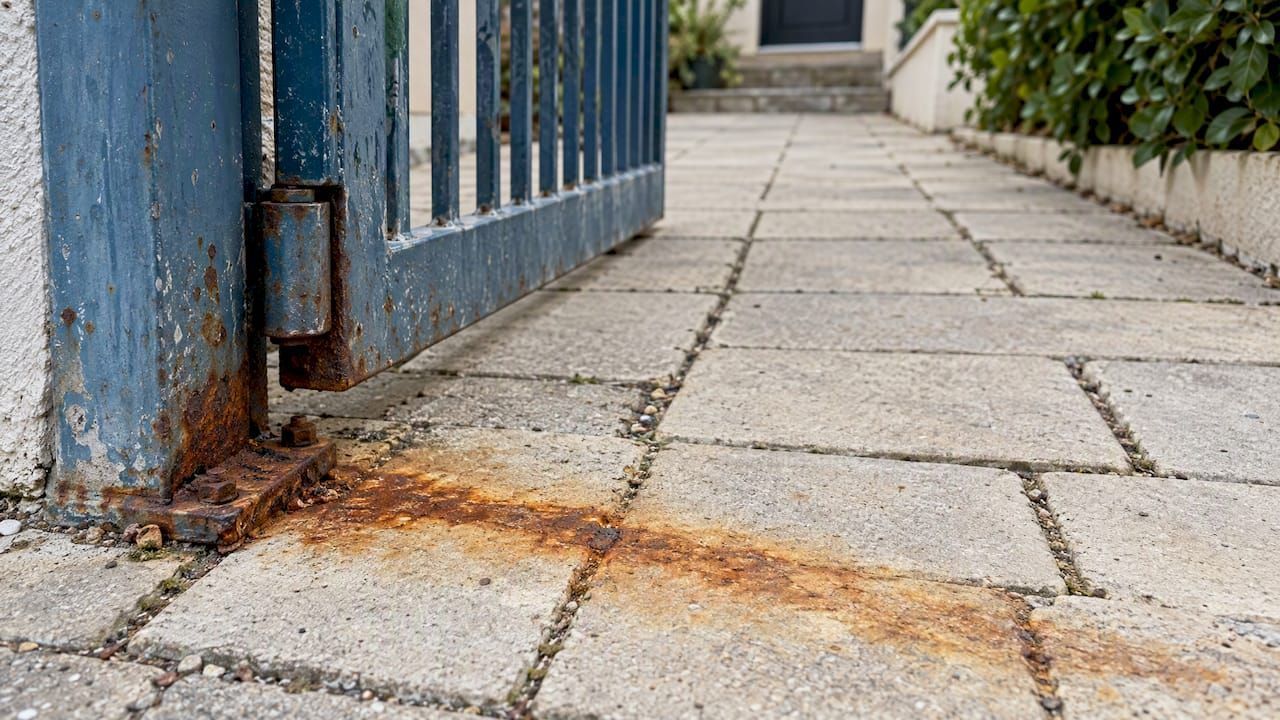
- Metal furniture and umbrella bases. Wrought iron, steel planters and cheap fasteners leave a mark in the exact shape of their feet, especially after rain.
- Fertilizer. Many granular lawn fertilizers contain iron. If granules land on pavers and sit through a rain or a sprinkler cycle, they can leave freckled orange spots. Sweep or blow them off the pavers right after spreading.
- Irrigation water. Sprinklers fed by well water that carries dissolved iron can paint orange fans on a driveway, wall or walkway. If matching stains show up on every surface the spray reaches, the water is the cause.
- Metal edging, rebar and tools. A steel shovel, wheelbarrow or paver edging left on wet pavers is enough.
- Iron inside the stone. Some natural stones, sandstone among them, contain iron minerals that oxidize on their own and show up as rusty spots or streaks.
The last category matters most. Surface rust deposited from outside and iron breaking out from within are different problems. Per the Tile & Stone Journal guidance, surface rust is typically lifted with pH-neutral or chelating products, while natural iron breakout can call for acid-based removers that have to be tested carefully so they do not damage acid-sensitive materials.
Work out what you are dealing with
Spend five minutes on diagnosis before you buy or mix anything.
- Look at the pattern. Round marks under furniture feet, a ring under a planter, a spray pattern across a wall: all point to something outside the paver. Random rust freckles scattered through the stone point to iron inside it.
- Check the paver type. Concrete pavers, clay brick pavers, travertine, limestone, marble, sandstone, granite and porcelain all behave differently. Calcium-based stones (limestone, marble, travertine) react to acid. Concrete is also acid-sensitive at the surface, because the cement paste dissolves. Granite and porcelain tolerate far more.
- Note the age. A fresh mark under a chair left out last week sits near the surface. A stain that has been baking for several summers has had time to move deeper.
- Remove the source. Move the furniture, sweep up the fertilizer, adjust the sprinkler head. Cleaning while the source is still active is wasted effort.
One caution from the research: rust stains are rarely permanent when the right chemistry is used, but they can become effectively impossible to remove if the wrong method drives the stain deeper into the substrate. Patience at this stage protects the paver.
Match the cleaner to the paver
| Paver type | Acid tolerance | Safer starting point |
|---|---|---|
| Limestone, marble, travertine | Very low | Test a poultice with a stone-safe, acid-free rust product; no muriatic or brick acid |
| Sandstone | Low to moderate | Gentle product first; test for natural iron breakout before anything stronger |
| Concrete and wet-cast pavers | Low at the surface | Mild cleaner, pre-wet, short dwell, rinse thoroughly |
| Clay brick | Moderate | Mild cleaner first; test strong products in a hidden spot |
| Granite, porcelain | Higher | Mild cleaner first; still test and rinse well |
This table is a starting point, not a guarantee. Always test.
Why household acids are a bad first move
Brick acid and muriatic acid are the products people reach for at the hardware store. On concrete and especially on limestone, marble or polished finishes, they can etch, burn or discolor the surface. The National Park Service's masonry cleaning guidance, Keeping It Clean, is a good read on this: aggressive chemical cleaning of historic masonry can harm the material it is meant to clean, and it warns against leaving acid-based cleaners to dwell too long. Its advice for commercial acid products is a dwell time of no more than about 5 to 7 minutes. We cover the mechanism in more depth in why acid cleaners harm stone and tile surfaces, and you can run a simple 24-hour tile drop test to see how a surface reacts before you commit.
Generic pool chemicals fall into the same trap. Do not use them on limestone, marble or polished surfaces unless the manufacturer explicitly approves that use.
Some masonry rust removers are formulated without muriatic, hydrochloric or sulfuric acids precisely to protect sensitive masonry from etching and color change. If you go that route, read the label for the surfaces it lists and follow it.
How to remove a fresh or light rust stain
This routine suits recent surface stains on concrete, brick and similar pavers.
- Sweep and dry-brush loose dirt, leaves and fertilizer granules off the area.
- Pre-wet the paver with clear water. This is the step most people skip. Historic masonry guidance in Keeping It Clean stresses pre-wetting because dry, porous stone lets the cleaner soak in rather than stay on the surface where the stain is. Wet the surrounding pavers too, so the product does not leave a clean halo.
- Test in a hidden spot. Pick a corner, an edge under a planter or a spare paver. Apply the product as directed, wait the stated time, rinse and let it dry fully. Judge the color once it is dry, not wet.
- Apply to the stain only, working from the outside edge of the stain inward so it does not spread.
- Agitate gently with a soft nylon brush. Skip wire brushes: steel bristles shed iron particles and can create new rust spots.
- Rinse thoroughly with plenty of clear water. Residue left in the pores can cause blotching later.
- Repeat if needed rather than leaving the product on longer. Several short, controlled passes are safer than one long one.
Two cautions that apply here. Wear gloves and eye protection with any rust remover, and keep runoff away from plants, pets and storm drains by following the label. Avoid high-pressure washing as a stain remover: it can scar the surface and push the stain deeper, and you have not addressed the chemistry anyway.
What about the home remedies?
Lemon juice, white vinegar and cola come up constantly in forums. They are mild acids, so they may lighten a very light surface stain on a tolerant paver. On limestone, marble or travertine, even vinegar can dull the finish. On concrete, results are inconsistent and can leave a lighter patch. If you want to try one, do it only after the water pre-wet and a hidden-spot test, and rinse well.
When the stain is deep: poulticing
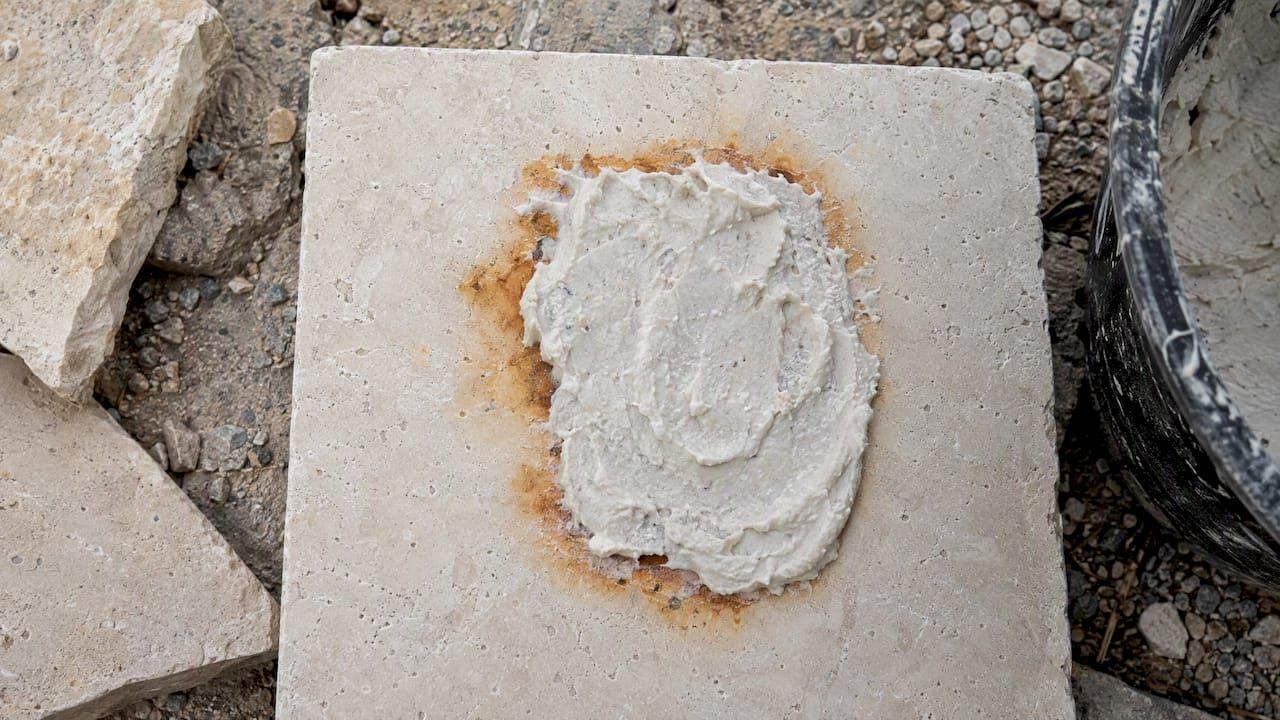
If a stain has not responded to a surface application, or it sits in stone like limestone or marble, a poultice is the professional approach. You mix a cleaning agent with an absorbent carrier such as diatomaceous earth or talc into a paste, spread it over the stain and keep it in contact with the stone so it can draw the rust out as it dries.
The General Services Administration's preservation guidance on poulticing rust stains from limestone and marble describes a set time of about 24 hours, with some applications running up to 48 hours. The GSA also publishes procedures for iron rust stains in concrete and for ferrous staining on brick, granite, concrete and limestone, which are worth reading if you have one of those materials.
The practical steps:
- Pre-wet the stone with clear water.
- Mix the poultice to a peanut-butter consistency.
- Apply it about a quarter inch thick, extending slightly past the stain edges.
- Cover with plastic and tape the edges so it does not dry out too fast.
- Leave it for the full set time. Removing it early or letting it dry out before it has worked often leaves the stain only partly gone.
- Remove, rinse thoroughly and let the paver dry before judging the result.
Stubborn stains can need a second poultice. That is normal. For marble specifically, see our walkthrough on poultice-first marble rust removal.
Is it rust or something else?
Orange, brown or white marks on pavers are not always rust.
- Efflorescence is a white, powdery salt deposit that rises from within concrete and brick. It is not rust, and it needs a different approach: see our steps for removing efflorescence from pavers.
- Tannin stains from leaves and mulch look brown and usually respond to an ordinary cleaner.
- Sunscreen and oil can leave yellowish or dark patches around pools; our guide to sunscreen stains on stone covers that.
- Mineral scale from hard water leaves chalky buildup; our piece on acid-free calcium removers explains how to handle it without harsh acids.
A quick test: a drop of water that darkens the spot and a stain that follows the shape of a metal object points to rust. A chalky crust that brushes off dry points to salts.
Our perspective: gentle chemistry first
Most damage we hear about does not come from the rust. It comes from the cleanup. A homeowner sees an orange mark, grabs the strongest acid on the shelf, and ends up with a bleached, etched patch that is larger and more visible than the original stain. Pavers are porous, so whatever you put on them goes in, and a surface that has been etched cannot be un-etched with a better cleaner. It needs a professional to hone or replace it.
That is why we build around acid-free, plant-based, biodegradable and low VOC formulas for stone, tile and other hard surfaces. Our view is simple: start with the mildest approach that could work, give it time, and escalate only when a test patch tells you to. Pre-wet, test, rinse, repeat. And if the stone is limestone, marble or travertine, treat any acid as off limits unless the product maker says otherwise for that stone.
We also think prevention is the cheapest fix. A good routine, a breathable sealer and a few small habits (felt or rubber pads under metal furniture, sweeping fertilizer away) keep most rust from ever setting in. If you are unsure which product suits your pavers, ask us before you pour anything on them.
Seal pavers after cleaning to stop the next stain
A clean, dry paver is the best time to protect it. A penetrating sealer slows how fast liquids and fine particles get into the pores, which gives you time to sweep or rinse a spill before it sets. It will not make a paver immune to rust, and heavy iron sources still need to be dealt with at the source, but it makes future cleaning easier.
Before you choose one, read about common problems with stone sealers and our guide to choosing the right stone sealer, since the right choice depends on the stone, whether it is sheltered or fully exposed, and how you want it to look.
Prevention habits that work:
- Put rubber or felt feet under metal furniture, and bring cushions and rusty items off the pavers when you are not using them.
- Use plastic or powder-coated planters rather than raw steel, and put a saucer under pots.
- Sweep or blow fertilizer off hard surfaces right after spreading.
- Aim sprinkler heads at the lawn. If well water leaves orange deposits, have the water tested and talk with an irrigation or water treatment professional about a filter.
- Clean spills and leaf litter promptly so they do not trap moisture against the stone.
Where our products fit
Oceancare makes eco-friendly, biodegradable, plant-based, low VOC and acid-free cleaners and sealers for pool tile, natural stone, grout, pavers and other hard surfaces. For routine upkeep of pavers and surrounding surfaces, our Home Essential Cleaners are a gentle place to start, and our Stone & Grout Sealers are for protecting surfaces once they are clean. If you maintain pools or manage properties, our pool tile maintenance products cover the deck and waterline side of the job too. Not sure what suits your stone? Tell us the paver material and the stain, and we will point you to the right product for that surface.
When to call a professional
Bring in a stone restoration specialist if:
- The pavers are polished marble, limestone or travertine and the stain has not moved after a test poultice.
- The surface is already etched or dulled, since that is a physical change that stain removers cannot fix.
- Stains cover large areas or run through the full depth of the stone.
- You suspect the source is rebar or metal embedded in the slab or base.
A pro will test the stone, choose the chemistry and, if needed, hone and refinish the surface. That is usually less costly than replacing damaged pavers.
FAQ
Can rust stains on pavers be permanent?
Rarely. With the right chemistry and enough contact time, most rust stains lift, according to Tile & Stone Journal. They become effectively permanent mainly when the wrong method pushes the stain deeper or when acid etches the surface. If a stain survives two careful attempts, ask a stone specialist.
How do I get rust off a concrete driveway or patio?
Find and remove the source, sweep the area, pre-wet with clear water and test a rust remover made for concrete in a hidden spot. Apply to the stain only, agitate with a nylon brush and rinse well. Skip wire brushes, which can leave new rust behind, and avoid long acid dwell times.
How do I get rust off flagstone or natural stone pavers?
Identify the stone first. Limestone and marble are acid-sensitive, so use a stone-safe, acid-free approach and a poultice left for 24 to 48 hours, as described in the GSA guidance. Sandstone and some flagstone contain natural iron, which may need a different, carefully tested approach.
Will pressure washing remove rust stains?
Usually not. Water pressure removes loose dirt but does not break down iron oxide, and too much pressure can scar pavers and drive the stain deeper. Use it only to rinse after a chemical or poultice treatment, at moderate pressure.
Sources
- How to remove rust from paving slabs, Tile & Stone Journal
- Keeping It Clean: Removing Exterior Dirt, Paint, Stains and Graffiti from Historic Masonry Buildings, National Park Service
- Poulticing rust stains from limestone and marble, GSA
- Removal of ferrous staining from brick, granite, concrete and limestone, GSA

