
Hard Water Stains on Quartz: How to Remove Them Safely
The white rings and cloudy spots on your quartz are almost always mineral deposits left behind when hard water evaporates, and most of them come off with a mild cleaner, a soft cloth and a little patience. Start gently: warm water and a drop of dish soap, then a diluted acidic step only if the deposit stays, then a rinse and a dry. The harder you scrub or the stronger the chemical you reach for, the more likely you are to turn a removable spot into a permanent dull patch.
This guide shows you how to tell a deposit from real damage, what to try in what order, what to keep away from the surface, and how to stop the spots from coming back.
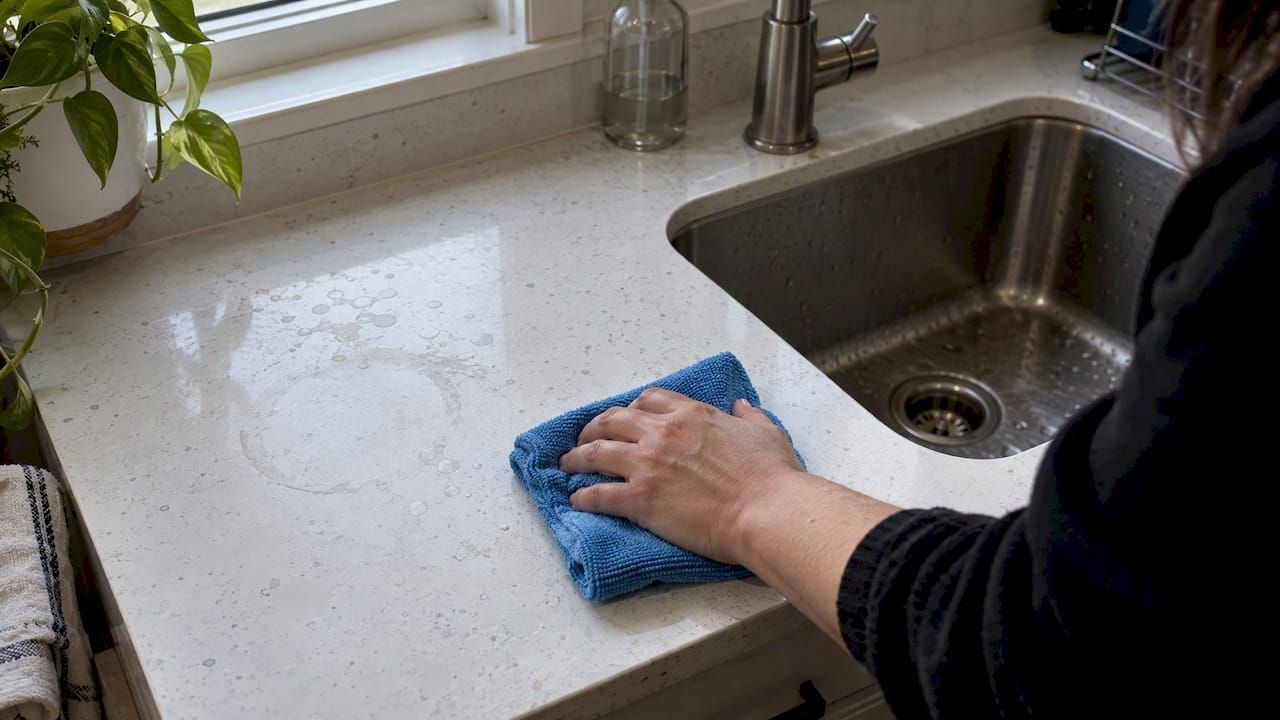
TL;DR
- Most hard water marks on quartz are calcium and magnesium deposits sitting on the surface. They are not true stains, and they are usually removable.
- Work from gentlest to strongest: soap and warm water, then a non-abrasive cleaner on a damp cloth, then a short, diluted vinegar contact with an immediate rinse.
- Never use bleach, oven cleaner, strongly alkaline products or abrasive pads, and never press harder than the weight of your hand.
- If a mark will not budge, it may be etching or a scratch, and no cleaner will fix it. Stop and call the fabricator or manufacturer.
- Drying the counter after use prevents most of the problem.
Table of Contents
- What hard water stains on quartz really are
- Remove hard water stains from quartz, step by step
- What not to use on quartz
- When the mark will not come off
- Stop hard water spots from coming back
- Our perspective: the pH question comes first
- A gentle daily option for quartz and other hard surfaces
- Frequently asked questions
- Sources
What hard water stains on quartz really are
Quartz countertops are engineered from ground quartz bound with resin. The surface is non-porous, so liquids do not soak in the way they do in marble or granite. That is why people are surprised when spots appear anyway. Caesarstone, a major quartz manufacturer, says plainly that quartz resists staining but is not completely stainproof.
What you are seeing is usually not a stain that went into the stone. It is a film that formed on top of it. Water described as hard carries high amounts of calcium and magnesium. When a droplet dries on the counter, the water leaves and the minerals stay. Repeat that around a faucet, a sink edge or a coffee station for a few months and the spots build into a crust or a hazy ring.
The Vermont Department of Health classes water at 121 to 180 mg/L (as calcium carbonate) as hard and anything above 180 mg/L as very hard. It also notes that hardness is a nuisance, not a health risk. It varies by source, and a private well can differ sharply from the municipal supply down the road. If your spots return within days, check your water report or use a test kit before you blame the counter.
Three marks that look alike
Before you clean anything, work out which of these you have. The fix is different for each.
| What you see | Likely cause | Typical fix |
|---|---|---|
| White, chalky or cloudy spots, often near the sink or faucet, that feel slightly rough | Mineral deposit (limescale) | Cleaning, in the order below |
| Dull or hazy patch with a smooth feel that did not change when you wiped it | Etching or a worn finish from chemicals or abrasion | Not a cleaning job. Ask the fabricator or manufacturer |
| Gray or dark streak that looks like a scratch | Metal transferred from pots, pans or utensils | A white latex eraser, used gently |
One quick test: wet the spot. A deposit often looks worse when dry and fades while wet, and it will feel gritty or raised when you run a fingertip across it. A damaged finish looks the same wet or dry.
The metal-mark confusion is common. Quartz maintenance guides note that what looks like a scratch is often metal transfer from cookware, and that a white latex eraser can lift it where scrubbing would only do harm.
Remove hard water stains from quartz, step by step
Do every step on a cool, clean counter. Heat makes products dry on the surface and leave their own residue.
Step 1: Wash with soap and warm water
This handles more than you would expect. MSI, a quartz and stone supplier, says warm water and a drop of dish soap is all that most daily messes need. Use a soft microfiber cloth and a mild, pH-neutral dish soap. Wipe in gentle circles, rinse the cloth, wipe again with clear water, then dry with a clean towel. Soap scum can mimic mineral spots, so this step often clears part of what you thought was limescale.
Step 2: Use a non-abrasive cleaner on a damp cloth
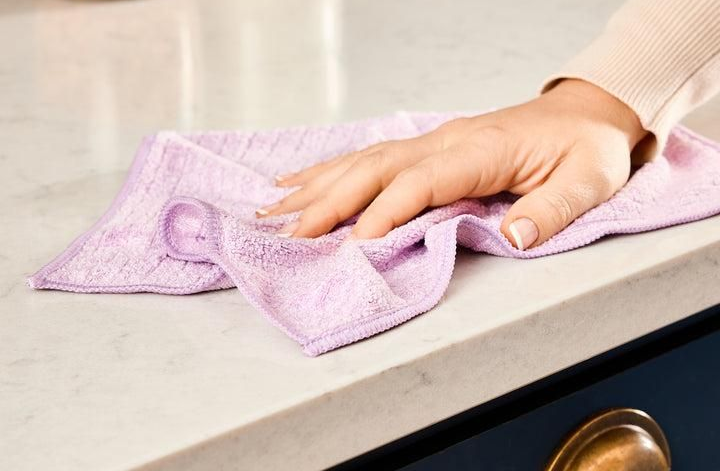
If a film remains, put a non-abrasive cleaner on a damp cloth, never straight onto the counter. Rub the spot in a small circular motion with light pressure. Caesarstone's own method is the same: apply to the cloth, rub gently, rinse thoroughly, then dry and buff.
On pressure, use the natural weight of your hand and nothing more. The HanStone care guide warns that even non-abrasive tools can leave dull spots when you press hard and mechanically alter the factory finish.
Step 3: Try diluted vinegar, briefly
For a deposit that survived steps 1 and 2, mineral deposits dissolve in mild acid. Caesarstone says a mix of half white vinegar and half water is often effective at dissolving the mineral deposits when applied with a soft cloth for a few minutes. That is the manufacturer's guidance, and it comes with conditions you should follow:
- Test a hidden spot first, such as the area behind the faucet or inside a cutout.
- Dilute it. Do not use straight vinegar.
- Apply with a cloth, leave it for a few minutes at most, and do not let it dry on the surface.
- Rinse with plenty of clean water and dry immediately.
The reason for the caution: acid can attack the resin binder. Other quartz suppliers and cleaning sources advise against leaving acidic products to dwell on the surface at all, and some brands do not endorse vinegar. If your manufacturer's care sheet says no acids, follow that sheet. Your warranty depends on it, so look up the brand stamped on your installation paperwork or ask the installer.
Step 4: Spot treatments for specific marks
Some manufacturers allow short-term use of 70% isopropyl alcohol or a white Magic Eraser-type sponge on stubborn marks, with an immediate rinse and a test first. Treat these as last resorts, since melamine sponges are mildly abrasive and can dull a polished finish if you rub. Better Homes & Gardens makes the same point in its guide: it is easy to cause more damage by using the wrong cleaning agents or tools.
A note on dark and matte quartz
Dark and honed or matte quartz shows water spots and any change in sheen more than white polished slabs do. Be extra conservative there. Test first, use the lightest touch, and skip any step that involves rubbing. A uniform finish is easier to dull unevenly than to repair.
What not to use on quartz
The fastest way to turn a removable deposit into permanent damage is the wrong product. Quartz manufacturers advise keeping these away:
- Bleach and oven cleaners. Harsh and strongly alkaline, and manufacturers explicitly advise against them.
- Scouring powders, steel wool and green scrub pads. They scratch the surface and leave dull patches.
- Undiluted vinegar, lemon juice and strong acid descalers left to sit. Acid that dwells can dull the resin binder.
- Razor blades and scrapers. A reader on one forum reports using CLR for a few minutes but would not use a razor, and the instinct is right. Scraping risks scratching the surface.
- Products labeled "stone safe" that you have not checked. The label is marketing. Read the ingredient list for citric, lactic, hydrochloric or phosphoric acid, and check whether the maker says the product is suitable for quartz.
This also answers a question people ask often: can you use CLR on quartz? It is a strong acidic descaler. Some homeowners report using it briefly, but it is not a safe default, many quartz makers do not recommend it, and one slip with dwell time can etch the surface. If you are considering it, check your manufacturer's care sheet first and test in a hidden spot.
When the mark will not come off
If you have followed steps 1 to 3 and the spot is still there, stop. Repeating stronger attempts is how counters get ruined. Common reasons a mark stays:
- It is etching. The finish itself is altered, usually by acid or an alkaline product that stayed on the surface. Cleaning cannot restore it.
- It is micro-scratching or abrasion. The light hits the rough patch differently, so it looks like a stain.
- The deposit is very old and thick. Mineral layers that have built up for months or years may need professional treatment.
In those cases, contact the installer, the fabricator or the quartz manufacturer. Tell them the brand, the color, what you used and for how long. They can tell you whether polishing or a professional restoration is an option.
Stop hard water spots from coming back
The most useful maintenance habit is not a cleaner. It is drying. A practical quartz care guide makes the point that the main source of "stains" is mineral deposits, so preventing buildup by drying promptly beats deep cleaning later.
What that looks like in a real kitchen or bathroom:
- Keep a dedicated towel by the sink. Wipe the counter edges and the faucet base after dishes or handwashing.
- Squeegee or wipe after wet use. Bathroom vanities with quartz tops collect the most droplets.
- Move the wet items. Dish racks, soap dishes, bottles and plant pots leave rings. Put them on a tray you can lift and dry.
- Use a daily pH-neutral cleaner. A mild soap or a cleaner without acids keeps the surface free of film that traps minerals.
- Consider water treatment. If your water is very hard, a softener or a filter at the tap changes the problem at the source. The Vermont health department notes that hardness varies even within an area, so test before you invest.
- Wipe spills quickly. Blot rather than smear, as MSI advises, so residue does not set.
For related surfaces in the same home, our guides on why preventing hard water stains matters and on removing calcium buildup from stone without acid cover the principles in more depth. If you also have glass shower doors or screens with the same problem, we explain a vinegar soak approach for hard-water-stained glass.
Our perspective: the pH question comes first
We make cleaning and maintenance products for hard surfaces, and the same mistake shows up across tile, natural stone, grout and quartz: people reach for the strongest thing under the sink because the mark looks serious. Usually the mark is a thin mineral film, and the strong product is what creates the lasting problem.
Our approach is built around that. We formulate plant-based, biodegradable, low-VOC and acid-free cleaners for surfaces that react badly to harsh chemistry, and we think the right order of operations matters more than any single product. Start with the mildest option that works. Test somewhere hidden. Rinse and dry every time. Let the surface tell you when to stop, because a mark that survives gentle cleaning is information, not a challenge.
We would also say that "natural" is not the same as "safe for your counter." What counts is the chemistry of the product and how long it stays on the surface. Read labels for acid ingredients and follow your surface manufacturer's care sheet first. That is what we would tell a friend in our own kitchen.
A gentle daily option for quartz and other hard surfaces
If you want a daily or weekly cleaner that avoids acid and harsh solvents, look at our Home Essential Cleaners. They are plant-based, biodegradable and low-VOC, made for hard surfaces around the house. For surfaces beyond quartz, such as natural stone countertops, floors and grout, our Stone & Grout Sealers help protect against stains and grime. Before you use any product on quartz, confirm that your countertop manufacturer's care sheet permits it and test a small hidden area first. For help choosing, our guide to safe, effective home cleaners walks through what to look for room by room.
Frequently asked questions
Can I use vinegar on a quartz countertop?
Some manufacturers allow a diluted mix, and Caesarstone suggests half white vinegar and half water for a few minutes. Test a hidden spot first, rinse well and dry straight away. Do not use it full strength or let it sit, because acid can dull the resin binder, and skip it entirely if your brand's care sheet says no acids.
Can quartz stain permanently?
Yes. Quartz is stain-resistant, not stainproof. Most hard water marks are removable deposits, but etching from harsh chemicals or a scratched finish from abrasive scrubbing is permanent. That is why gentle methods and prompt drying matter.
Is a Magic Eraser okay on quartz?
Some manufacturers allow a white melamine sponge on stubborn marks for short periods, with a test patch and an immediate rinse. It is mildly abrasive, so it can dull a polished or dark surface if you rub. A white latex eraser is the milder choice for gray metal marks.
Why do water spots keep coming back on my quartz?
Likely because your water is hard and droplets are drying on the surface. Wiping the counter dry after use stops most spots. If they return within days, test your water hardness, since it can differ between a well and a municipal supply, and consider a softener or tap filter.
Sources
- Caesarstone: How to Safely Remove Hard Water Stains From a Quartz Countertop
- Vermont Department of Health: Hardness in Drinking Water
- MSI Surfaces: How to Remove Stains from Quartz Countertops
- HanStone Quartz Countertop Maintenance guide (PDF)
- Better Homes & Gardens: How to Remove Stains From Quartz Countertops
- Quartz Stone Maintenance: The Complete Cleaning & Care Guide

