
Why acid cleaners harm your stone and tile surfaces
TL;DR:
- Acid cleaners quickly damage natural stone surfaces and grout through chemical reactions.
- Switching to pH-neutral, eco-friendly cleaners offers effective cleaning without long-term surface deterioration.
- Regular use of acid-based products leads to invisible, cumulative damage that shortens surface lifespan.
Acid cleaners have a reputation for cutting through tough grime quickly, which makes them feel like the obvious choice for your stone floors, pool tiles, and grout lines. But that satisfying result comes with a serious hidden cost. Many homeowners and property managers are unknowingly stripping away the very surface they're trying to clean, causing invisible damage that compounds with every use. This guide covers the real science behind acid damage, the surfaces most at risk, and the practical eco-friendly alternatives that deliver lasting results without the regret.

Table of Contents
- What are acid-based cleaners and where are they used?
- How do acids damage natural stone and grout?
- Edge cases and misconceptions: Not all stone reacts equally
- Safer alternatives: Eco-friendly cleaning strategies for hard surfaces
- What most homeowners and managers miss about acid-based cleaning
- Better cleaning, safer surfaces: Upgrade your routine with eco-friendly solutions
- Frequently asked questions
Key Takeaways
| Point | Details |
|---|---|
| Acids dissolve stone surfaces | Even weak acids like vinegar rapidly etch and degrade marble, limestone, and travertine. |
| Grout weakens with acid use | Repeated acid exposure can reduce grout strength by up to 50% and cause permanent surface dullness. |
| Granite and slate not immune | Granite and slate can resist acids initially but will deteriorate with repeated acid cleaning. |
| Choose safer alternatives | pH-neutral and eco-friendly cleaners clean effectively without risk to stone or grout integrity. |
| Health risks are significant | Acid-based cleaners can cause hazardous fumes and burns, requiring careful handling and ventilation. |
What are acid-based cleaners and where are they used?
Acid-based cleaners are exactly what they sound like: cleaning products formulated with acidic compounds that use chemical reactions to dissolve mineral deposits, grout haze, and staining. You'll find acids in more household products than most people realize.
Common acids found in cleaning products include:
- Vinegar (acetic acid): A popular DIY cleaning choice, often recommended online for "natural" cleaning
- Muriatic acid (hydrochloric acid): Used for heavy-duty pool tile cleaning, concrete etching, and grout haze removal
- Phosphoric acid: Found in rust removers, some tile cleaners, and descaling agents
- Citric acid: Present in many "natural" cleaning products but still acidic enough to cause stone damage
- Sulfamic acid: Common in grout haze removers and descalers
These products get used for removing hard water stains from glass and tile, stripping grout haze after new tile installation, cleaning calcium deposits from pool tiles, and breaking down soap scum in bathrooms and showers. They work fast, which is precisely why people trust them. But fast chemistry cuts both ways.
The health and safety risks from acid cleaners include skin and eye irritation, respiratory issues from fumes such as hydrogen chloride gas, and severe chemical burns. Proper personal protective equipment, gloves, goggles, and ventilation are required whenever these products are in use. And that's before you consider what they're doing to your surfaces.
| Cleaner | Acid type | Primary use | Risk level |
|---|---|---|---|
| White vinegar | Acetic acid (5%) | DIY tile/grout cleaning | Moderate (stone damage) |
| Muriatic acid | Hydrochloric acid | Pool tile, concrete | Very high |
| Rust remover | Phosphoric acid | Rust/mineral stain removal | High |
| Grout haze remover | Sulfamic acid | Post-installation cleanup | High |
| Citrus spray cleaners | Citric acid | General surface cleaning | Low to moderate |
For daily cleaning that skips these risks entirely, pH-neutral daily care is the smarter habit for any stone or tile surface. Understanding marble maintenance basics also helps homeowners recognize which products are safe before a single drop touches a valuable surface.
How do acids damage natural stone and grout?
Here's what actually happens when an acid-based cleaner makes contact with natural stone. It's not cleaning the surface. It's dissolving it.
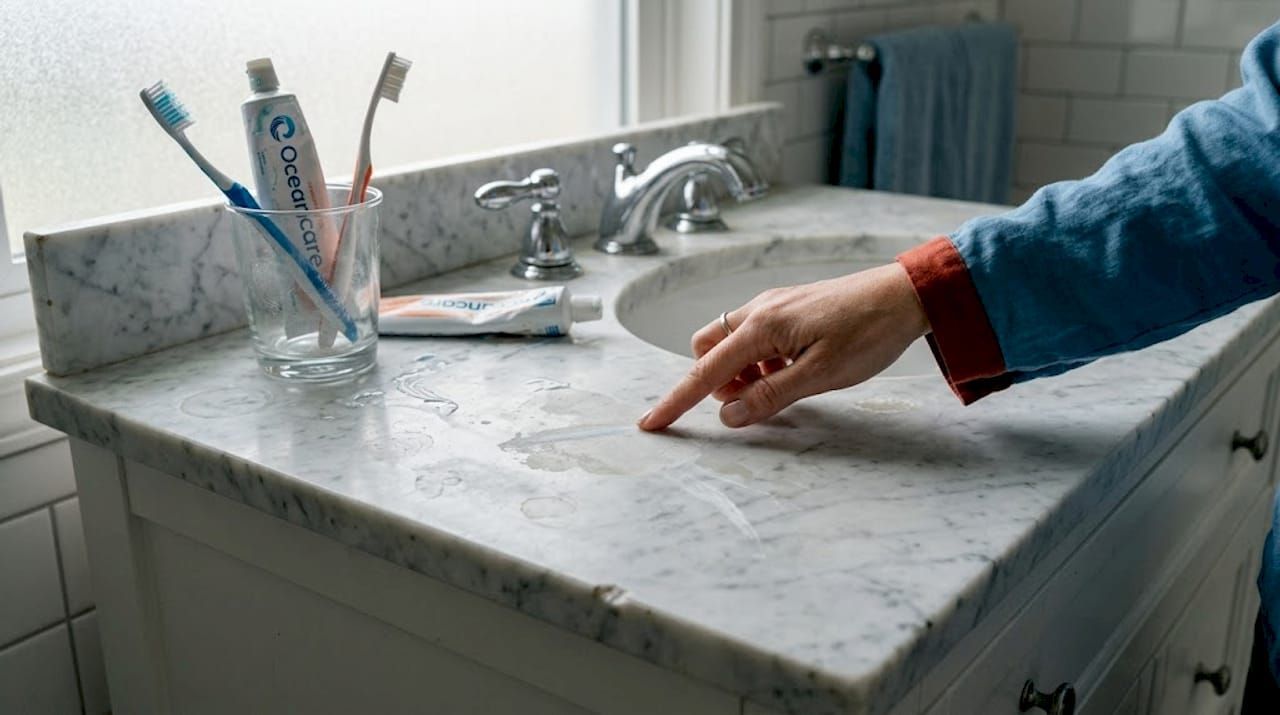
Most natural stone, including marble, travertine, and limestone, is composed primarily of calcium carbonate (CaCO3). Acids trigger an immediate chemical reaction: the acid protonates the calcium carbonate, producing calcium ions, water, and carbon dioxide gas. The surface literally releases material when acid is applied. This CaCO3 + 2H+ reaction means that even mild acids like vinegar at 1% concentration can visibly etch a polished marble surface within just 8 seconds, according to ASTM C241 test standards. That's not a slow, gradual problem. That's near-instant damage.
What does this look like in practice? Etching appears as dull spots, loss of reflectivity, or a rough, chalky texture on a surface that was previously smooth and glossy. Many homeowners mistake early etching for a cleaning residue or water spots and try to clean it away with more acid, making the problem significantly worse.
| Stone type | Calcium carbonate content | Acid sensitivity | Visible damage risk |
|---|---|---|---|
| Marble | Very high (90%+) | Extreme | Etching in seconds |
| Travertine | High | Extreme | Rapid pitting |
| Limestone | High | Extreme | Surface erosion |
| Granite | Low | Moderate | Dulling over time |
| Slate | Very low | Lower | Slower degradation |
| Ceramic tile | None (glaze varies) | Low to moderate | Glaze dulling |
| Cement grout | Moderate (Portland cement) | High | Structural weakening |
Grout deserves particular attention here. Cement-based grout contains calcium silicate compounds that react with acids similarly to stone. Repeated acid exposure weakens grout by 30 to 50% structurally, causing it to crumble, crack, and allow water infiltration behind tiles. This leads to mold, loose tiles, and costly repairs.
Statistic to note: A single cleaning with 5% muriatic acid solution is enough to cause measurable surface loss on marble and noticeably weaken grout lines. Regular use over months or years compounds this effect dramatically.
For those dealing with grout issues, safer grout cleaning methods remove grime without compromising structural integrity. For heavily soiled stone that needs real power without acid chemistry, intensive stone cleaning concentrates can do the job safely.
Pro Tip: Before using any cleaner on a stone surface, test a small, hidden spot and wait 24 hours before proceeding. This reveals sensitivity issues before they appear on a visible area. But remember, a single test doesn't predict long-term cumulative damage.
Edge cases and misconceptions: Not all stone reacts equally
A common pushback from homeowners goes something like this: "I use mild acid cleaner on my granite countertops and it looks fine." And that may be true, today. But the key word is today.
Granite has a much lower calcium carbonate content than marble or limestone, which means it resists the immediate, visible etching those stones show. Slate behaves similarly. But the protection is relative, not absolute. Acids still attack the silicate bonds and mineral matrix in granite over time, and the evidence appears as a gradual loss of luster, micro-scratching that catches light differently, and eventual surface degradation that no amount of polishing can fully reverse.
Surfaces at highest risk from acid cleaners:
- Marble (polished, honed, or tumbled) — extremely sensitive to any acid contact
- Travertine — the porous nature allows acids to penetrate deeply, causing interior as well as surface damage
- Limestone — essentially the same chemistry as marble but often used outdoors where pool chemicals add further risk
- Polished granite — the polish is more vulnerable than the underlying stone itself
- Sanded and unsanded cement grout — both weaken structurally with repeated exposure
- Saltillo and terracotta tile — often sealed, but the underlying material reacts badly to acids
The edge case truth is that granite and slate resist initial acid etching but degrade with repeated exposure, and polished or honed marble, limestone, and travertine should never be treated with any acid-based product, regardless of dilution.
"Even 'robust' stones like granite will show dulling and fading over repeated acid cleaning cycles. The damage is invisible until it's irreversible."
One of the most important but misunderstood points: testing a small area is a useful short-term check, but it won't tell you anything about the cumulative effect of using an acid cleaner every week for a year. The damage builds invisibly across the entire surface, becoming obvious only after the harm is already done.
Avoiding common cleaner mistakes is the first practical step. Understanding eco-friendly cleaning tips helps you build a routine that protects your surfaces over the long term instead of just winning the visual battle today.
Safer alternatives: Eco-friendly cleaning strategies for hard surfaces
The good news is that switching to safer cleaning methods doesn't mean accepting weaker results. Modern pH-neutral and enzymatic cleaners are specifically formulated to remove the deposits and grime that acid cleaners target, without the chemical violence those products bring to your surfaces.
How to build a safer, more effective stone and tile cleaning routine:
- Start with dry removal. Sweep or vacuum stone floors and tile surfaces before any wet cleaning. This removes grit that can scratch polished stone during mopping.
- Use pH-neutral cleaner for daily and weekly maintenance. A good pH-neutral cleaner won't react with calcium carbonate, so it cleans without etching. Look for plant-based, biodegradable formulas that rinse cleanly without leaving residue.
- Address spills immediately. Wine, coffee, citrus juice, and vinegar-based dressings are all acidic. Blot spills quickly and rinse with clean water. Don't scrub, which drives the acid deeper.
- Use enzyme-based cleaners for organic stains. These break down grease, protein-based stains, and biological matter without harsh chemistry.
- Choose specialized cleaners for specific problems. Hard water calcium deposits on pool tiles, for example, respond well to chelating agents that sequester calcium without dissolving the surface underneath.
- Seal stone and grout regularly. An appropriate penetrating sealer limits how deeply stains and moisture can penetrate, making routine cleaning far easier and more effective.
- Schedule deep cleaning periodically. Rather than reaching for acids when buildup gets heavy, bring in a specialist-grade eco-friendly stone cleaner designed for deep restoration without the damage risk.
The ASTM C217 standard confirms that pH-neutral products maintain surface gloss over time, while acid exposure progressively reduces it. That's real, measurable data supporting what professional stone care specialists have advocated for years.
Pro Tip: Establish a consistent weekly cleaning schedule using only pH-neutral products. Buildup prevention is far easier than buildup removal. When surfaces stay clean through regular gentle care, there's never a situation where you're tempted to reach for something more aggressive.
What most homeowners and managers miss about acid-based cleaning
Here's what most cleaning guides won't tell you: the satisfying result you see after using an acid cleaner isn't the surface being cleaned. It's the surface being consumed.
That bright, shiny result after an acid treatment often comes from the dissolution of the outermost layer of stone or grout. Acids remove the mineral layer that was trapping staining, which is why the surface looks cleaner. But that mineral layer was also the surface itself. Every acid cleaning session is removing material that cannot be replaced. What looks like a result is actually a loss.
Professional stone restoration specialists have been moving toward "least invasive" methods for decades, and the shift isn't about being gentle for its own sake. It's because cumulative micro-etching, the invisible damage that builds up across dozens of acid cleaning sessions, is now one of the leading causes of premature stone surface failure in residential and commercial settings. The surface doesn't fail dramatically. It just slowly stops looking right, loses its reflectivity, develops a rough texture that traps more dirt, and eventually requires full professional restoration or replacement.
The other factor most people underestimate is the timeline. A stone surface that looks fine after six months of acid cleaning may look noticeably dull and rough after two years. By that point, the chemical damage is widespread and deep. A pH-neutral concentrate for stone costs no more than a typical acid-based product, but it delivers results that don't carry a hidden long-term price tag.
Real performance from eco-friendly, pH-neutral, and plant-based cleaners has improved dramatically. These products now match and frequently outperform acid-based alternatives for everyday cleaning, without any of the surface risk, health hazard, or environmental impact. The argument for sticking with acid cleaners isn't about effectiveness anymore. It's purely habit.
Better cleaning, safer surfaces: Upgrade your routine with eco-friendly solutions
If reading this has made you rethink what's currently under your kitchen sink or in your pool shed, you're not alone. Making the switch to acid-free surface care is one of the most impactful changes a homeowner or property manager can make for both their surfaces and their household health.
At Oceancare Store, the entire product range is built around this principle: high-performance cleaning that never compromises your surfaces or your health. From daily maintenance to deep restoration, every product is formulated to be biodegradable, plant-based, low VOC, and genuinely effective on natural stone, pool tiles, and grout. The shop pH-neutral cleaner is the perfect starting point for any stone or tile surface, while the full range of Home Essential Cleaners covers every surface in your home without the risk. For those newer to eco-friendly cleaning, the eco-friendly cleaning essentials guide is a great resource to explore the full picture before you shop.
Frequently asked questions
Can I use vinegar or lemon juice to clean marble countertops?
No. Even mild acids like vinegar or lemon juice etch marble visibly within seconds of contact, causing permanent dull spots that require professional polishing to correct.
What happens if acid gets on grout or tile accidentally?
Acid exposure can weaken grout structurally and dull tile surfaces, leaving permanent marks. Rinse the area with water immediately and switch to pH-neutral cleaners, since repeated acid weakens grout by 30 to 50% over time.
Are any stones truly acid-proof for cleaning?
No stone is completely acid-proof. Granite and slate are more resistant to immediate etching but still degrade with repeated acid exposure, making pH-neutral cleaning the right approach for all stone types.
What is the safest type of cleaner for daily care of stone surfaces?
A pH-neutral cleaner is the safest and most effective option for daily stone care, protecting surface gloss and structure over time. ASTM C217 testing confirms that pH-neutral products maintain gloss while acid-based cleaners gradually reduce it.
Do acid-based cleaner fumes pose a health risk indoors?
Yes. Acid-based cleaners can release hazardous fumes indoors, and the health and safety risks include skin irritation, eye damage, and serious respiratory problems, especially in enclosed spaces with poor ventilation.
Recommended
- pH Neutral Tile & Stone Cleaner: Daily Care for Hard Surfaces
- pH Neutral Tile & Stone Cleaner Concentrate: Daily Care for All Surfaces
- How to Deep‑Clean Grout Without Harsh Acids
- Are Your Home Cleaners Damaging Surfaces? Avoid These 5 Mistakes
- 6 Expert Commercial Stone Care Tips for Facility Managers

