
What is commercial stone restoration: a guide
TL;DR:
- Commercial stone restoration involves mechanical repair, refinishing, and sealing to restore natural stone's appearance and durability. It employs techniques like honing, polishing, sealing, and crack repair to remove damage and rebuild the surface, differentiating it from routine cleaning. Proper restoration and sealing extend the lifespan of stone surfaces, reduce maintenance costs, and promote eco-friendly care practices.
Most homeowners assume regular mopping and cleaning is enough to keep natural stone looking its best. It is not. Understanding what is commercial stone restoration reveals a much more serious process that goes well beyond surface cleaning. It involves mechanically repairing, refinishing, and protecting stone that has been scratched, etched, stained, or dulled by years of use. Whether you manage a property or maintain a home with marble countertops, stone floors, or pool tiles, knowing the difference between cleaning and true restoration could save you thousands in unnecessary replacement costs.
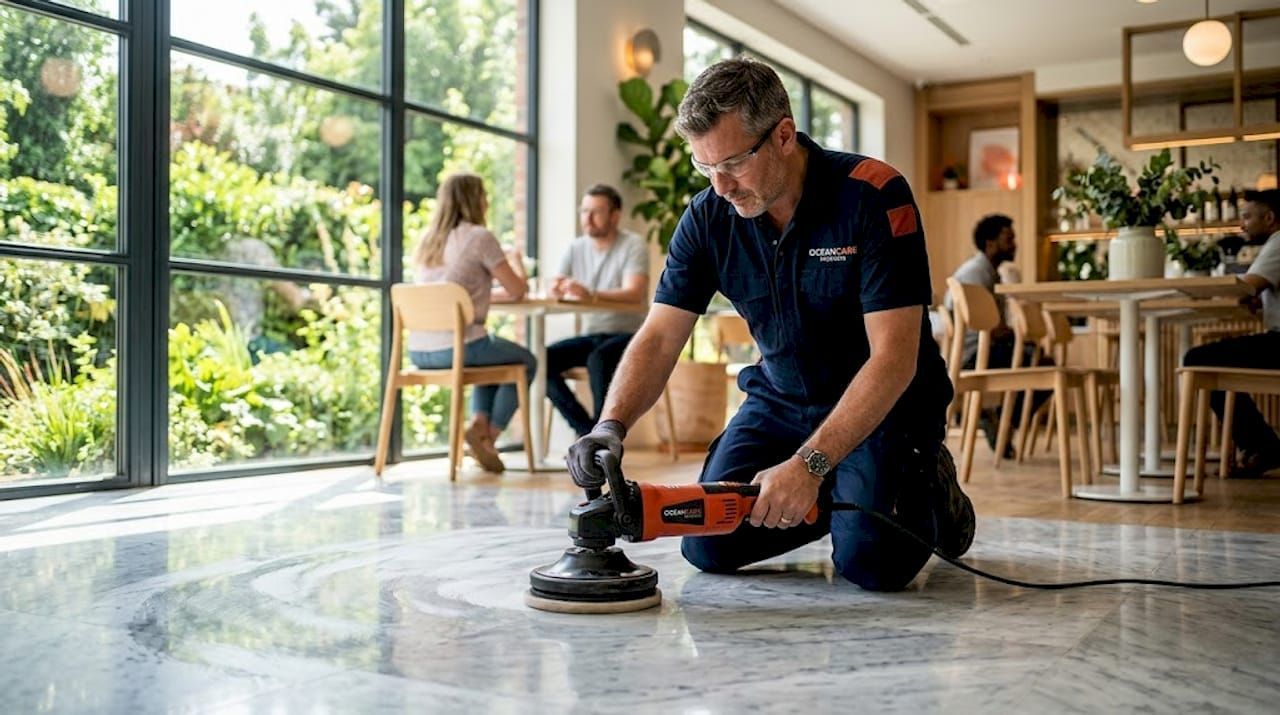
Table of Contents
- What is commercial stone restoration and how does it work?
- Key techniques used in commercial stone restoration
- Why restoration is different from cleaning and why it matters
- Eco-friendly considerations and maintenance after restoration
- Restoration applications for homeowners and property managers
- Why choosing the right restoration approach saves money and the environment
- Restore and protect your stone surfaces with Ocean Care
- Frequently asked questions
What is commercial stone restoration and how does it work?
Many people discover the hard way that scrubbing harder does not fix a dull, scratched stone surface. That is because the damage is structural, not cosmetic. Commercial stone restoration is a professional process that cleans, repairs, refines, and seals natural stone to restore its intended finish and durability. It is fundamentally distinct from routine cleaning or from replacing the stone entirely.
The natural stone restoration process follows a clear sequence. Technicians begin by assessing the damage, then work through honing, polishing, and finally sealing to bring the stone back to its original condition. Each phase serves a specific purpose. Skipping one compromises the final result.
Here is what each stage accomplishes:
- Honing: Uses abrasive pads (from coarse to fine grit) to grind away scratches, etching, and surface wear without yet creating a sheen
- Polishing: Refines the surface further with very fine abrasives or crystallization compounds to rebuild the stone's natural shine
- Sealing: Applies a protective barrier that prevents future staining and moisture absorption
- Crack and chip repair: Fills structural damage with color-matched epoxies or resins before polishing begins
Restoration does not just clean stone. It removes the damaged surface layer and rebuilds the finish from scratch, which is why it delivers results that no cleaning product can replicate.
This process works on marble, travertine, limestone, granite, terrazzo, slate, and most other natural stone types. Each stone requires different abrasive pressures and sealer types, which is why professional stone restoration matters so much. A misstep on soft limestone treated as if it were granite can cause more damage than the original wear.
Key techniques used in commercial stone restoration
With a basic understanding of the process, let us look more closely at the specific techniques that make stone restoration services effective at reversing years of damage.
The four main techniques, in order of application, are:
- Diamond grinding: Heavy-duty machinery fitted with diamond abrasive discs levels uneven stone, corrects lippage (height differences between adjacent tiles), and removes deep gouges. This is the starting point for severely damaged floors.
- Honing: Progressively finer diamond pads smooth the surface after grinding. The technician works from coarse grits to fine ones, removing previous scratch patterns at each stage.
- Polishing: The final abrasive stage brings the stone to the desired finish, from a flat matte to a high-gloss mirror. For high-traffic commercial floors, diamond abrasive methods progress from lippage correction through increasingly fine polishing passes to reach the target finish.
- Sealing: Locks in the restored surface and protects against future damage. The choice of sealer (penetrating vs. topical) depends on the stone type and its location.
The reason these steps cannot be shortcut comes down to physics. Polishing alone cannot substitute for honing when the damage is mechanical. Scratches and etching physically remove stone material. You have to grind away the damaged layer to reach undamaged stone beneath before any polish can work.
Pro Tip: Always ask your restoration contractor about their grit progression sequence. Jumping from a coarse to a very fine grit skips intermediate scratch patterns, leaving visible clouding in certain lighting conditions.
Here is a quick comparison of the main finishing levels and when each is appropriate:
| Finish type | Grit range | Best for | Maintenance level |
|---|---|---|---|
| Matte/honed | 200 to 400 | Bathrooms, high-traffic floors | Low (hides wear) |
| Semi-polished | 800 | Hallways, reception areas | Medium |
| High polish | 1500 to 3000 | Countertops, showrooms | High (shows fingerprints) |
| Mirror finish | 3000+ | Feature walls, marble lobbies | Very high |
Sealer selection deserves its own conversation. The importance of sealing natural stone cannot be overstated, particularly for porous stones like travertine and limestone. Penetrating sealers soak into the stone and block moisture from within, while topical sealers coat the surface and alter its appearance. For eco-conscious homeowners, sustainable natural stone sealers made with low-VOC, plant-based formulations protect the stone without off-gassing harsh chemicals into your home.

Why restoration is different from cleaning and why it matters
Understanding the key differences helps in knowing when restoration is necessary beyond simple cleaning.
Cleaning removes what is sitting on top of the stone: dirt, grease, hard water deposits, and biological growth. It is essential and should happen regularly. But cleaning cannot repair mechanically damaged surfaces. A cleaning crew can make a dull stone floor sparkle temporarily, but without mechanical restoration, the scratches and etching remain. The shine disappears within days.
What restoration actually does is more significant: it corrects mechanical damage to the stone itself, removes the scratched and dulled surface layer, re-establishes the crystalline polish, repairs cracks and chips, and applies appropriate protection. That is a fundamentally different scope of work.
Here is where many property managers go wrong:
- Using acidic cleaners on acid-sensitive stone like marble and limestone, which causes chemical etching
- Applying wax-based products that build up and trap dirt, creating a maintenance cycle that damages the stone over time
- Relying on daily cleaning crews to restore what only mechanical abrasion can fix
- Delaying restoration until damage is so severe that replacement becomes the only option
Pro Tip: If your stone surface looks clean right after mopping but dull within an hour, the problem is not dirt. It is surface etching or micro-scratches that only restoration can address.
The cost argument alone justifies paying attention to this distinction. Restoration typically runs a fraction of the price of full stone replacement. New natural stone flooring for a medium-sized commercial space can cost tens of thousands of dollars when you include material, removal, and installation. Restoration of the same area often costs 70 to 80 percent less. Addressing common issues with stone sealers early, before they escalate into physical stone damage, extends that cost advantage even further.
Eco-friendly considerations and maintenance after restoration
Now that you know the restoration process and why it is needed, here is how to maintain your stone surfaces sustainably to keep them beautiful longer.
The sealer you choose after professional restoration directly affects both the stone's longevity and your environmental footprint. Penetrating vs. topical sealers and the specific stone type and usage together determine long-term maintenance outcomes. The wrong product creates adhesion failures, surface haziness, or chemical incompatibility with your regular cleaners.
Resealing is recommended every 12 to 24 months depending on traffic and stone type. Pool surrounds and kitchen counters need attention more frequently than a guest bathroom floor.
For daily and weekly maintenance after restoration, follow these practices:
- Use pH-neutral cleaners specifically formulated for natural stone. Avoid anything labeled "all-purpose" unless it explicitly states compatibility with natural stone.
- Avoid bleach, vinegar, lemon juice, and ammonia-based products. They chemically etch polished surfaces.
- Choose low-VOC, biodegradable formulations wherever possible. These protect your indoor air quality and are safe for households with children, pets, or sensitivities.
- Wipe up spills immediately. Even sealed stone can absorb acidic liquids like wine or citrus juice if left sitting.
- Use soft mop heads and microfiber cloths. Abrasive scrubbers scratch polished stone.
Pro Tip: Test your regular cleaner on a small hidden area of freshly sealed stone. If the sealer clouds or the stone loses its sheen, switch products before you use it on the full surface.
Here is a practical reference for resealing frequency based on stone type and location:
| Stone type | Indoor low traffic | Indoor high traffic | Pool/outdoor |
|---|---|---|---|
| Marble | 24 months | 12 months | 6 to 12 months |
| Granite | 24 months | 18 months | 12 months |
| Travertine | 18 months | 12 months | 6 months |
| Limestone | 12 months | 6 to 9 months | 3 to 6 months |
| Slate | 24 months | 18 months | 12 months |
For eco-friendly stone maintenance tips that go beyond the basics, and for guidance on how sealers protect pool tile and stone surfaces in wet environments, sustainable care routines make a measurable difference in how long your restoration results last. Protecting natural stone is not just an aesthetic decision. It is a financial one.
Restoration applications for homeowners and property managers
With eco-friendly upkeep covered, let us see how restoration fits into your home or property management routine.
Natural stone appears in more places than most people realize. Each location has its own specific restoration and maintenance needs. Restoration revives countertops, floors, and showers by removing surface wear and rebuilding a uniform finish. Most cosmetic issues resolve at significantly lower cost compared to replacement.
Specific applications worth knowing:
- Kitchen countertops: Marble and limestone countertops are highly susceptible to etching from acidic foods and cleaning products. Restoration hones away etch marks and polishing rebuilds the surface gloss. A full countertop restoration typically takes half a day.
- Bathroom floors and walls: Grout lines and stone tiles in showers accumulate soap scum, hard water minerals, and mold. After restoration, proper sealing prevents re-soiling and mold regrowth. For a full approach, eco-friendly stone care for bathrooms addresses both the stone and the grout safely.
- Hallways and common areas: High-foot-traffic zones in apartment buildings, hotels, and offices show wear fastest. Diamond grinding and polishing restore uniformity across large floor areas quickly and without the disruption of demolition.
- Pool tiles and surrounds: Calcium buildup, chlorine exposure, and constant wet-dry cycles degrade pool tiles aggressively. Specialized pool tile restoration solutions handle calcium scale removal and reseal the surface against future mineral deposit bonding.
Pro Tip: For pool areas, always use sealers specifically rated for submerged or splash-zone applications. Standard stone sealers fail quickly under continuous water exposure and chlorine chemistry.
When working with stone and grout in multiple areas, sourcing stone and grout sealers designed to work together ensures chemical compatibility and uniform protection across both surfaces.
Why choosing the right restoration approach saves money and the environment
Here is something the stone care industry does not talk about enough: most stone damage in residential and commercial properties is self-inflicted. Not by the homeowner's neglect, but by well-intentioned cleaning programs using the wrong products.
Wax-based floor finishes are the most common offender. They feel like protection but behave like a trap. They build up in layers, yellow under UV light, and lock in dirt at each successive application. Stripping them requires harsh chemical strippers that, ironically, damage the stone further. Traditional wax finishes require repeated labor, chemical use, and cause surface damage, whereas mechanical diamond polishing creates durable finishes that reduce maintenance by up to 60%. That is not a minor efficiency gain. It changes the entire cost and environmental profile of owning stone surfaces.
The sealer chemistry point matters more than most people realize. A penetrating silicone-based sealer on a highly polished marble surface can cause surface hazing because the stone's tight crystalline structure does not absorb it evenly. The same sealer on travertine works beautifully. Choosing wrong does not just waste product. It can require full stripping and re-restoration before you can apply the correct product.
From an environmental standpoint, common stone sealer problems often lead to reapplication cycles that increase chemical waste and VOC exposure. Getting sealer selection right the first time is genuinely the greener choice, not just the practical one.
The bigger picture is this: a properly restored and correctly sealed stone surface requires less cleaning product, less frequent professional intervention, and lasts significantly longer before needing restoration again. That is less chemical runoff, less labor, and less material consumption. For property managers balancing budgets and sustainability goals, that equation is compelling.
Restore and protect your stone surfaces with Ocean Care
If you are ready to act on what you have learned, the products you use between professional restoration visits matter as much as the restoration itself.
At Ocean Care, every product in our range is formulated specifically for natural stone and pool tile surfaces. Our pool tile restorer tackles calcium buildup and mineral staining without acids that damage grout or surrounding stone. Our full range of stone and grout sealers uses low-VOC, plant-based chemistry designed to protect restored surfaces without introducing harsh compounds into your home or pool water. For ongoing care, our pool tile maintenance solutions keep your pool surfaces clean and sealed between professional services. These are the tools that make restoration last.
Frequently asked questions
How often should a sealed stone surface be resealed?
Sealed stone surfaces typically need resealing every 12 to 24 months, depending on the stone type and level of foot traffic, with high-traffic areas requiring more frequent attention.
Can cleaning crews perform stone restoration?
No. Cleaning cannot restore mechanically damaged surfaces. Scratches, etching, and surface wear require specialized restoration equipment and expertise that cleaning crews do not typically have.
Is waxing a good method to maintain natural stone surfaces?
It is not. Traditional wax finishes build up and yellow over time, trapping dirt and requiring aggressive stripping that damages the stone. Mechanical polishing and proper sealing deliver more durable, eco-friendly results.
How long does a professional stone restoration project typically take?
Most projects are completed within 3 to 5 days using diamond grinding, polishing, and sealing, though the timeline varies based on surface area and the extent of damage.

