
Stone Care Must-Haves: Your Complete Maintenance Kit
Your stone care kit needs these items before anything else: a pH-neutral cleaner , a penetrating (impregnating) sealer , microfiber cloths , a non-treated dry dust mop , a squeegee , a soft-bristled nylon brush , a poultice kit , non-slip entry mats , and basic PPE (nitrile gloves and safety glasses). That is the complete checklist, backed by the Natural Stone Institute and the Marble Institute of America (MIA), and it is what Oceancarestore builds its product line around.
Two rules matter more than anything else:
- Do blot spills immediately and rinse surfaces with clean water after cleaning.
- Don't use vinegar, lemon juice, bleach, or ammonia on any natural stone.
Those two acids and two alkaline agents are the most common causes of permanent etching and dullness on stone surfaces. Keep them away from marble, granite, travertine, and every stone in between.
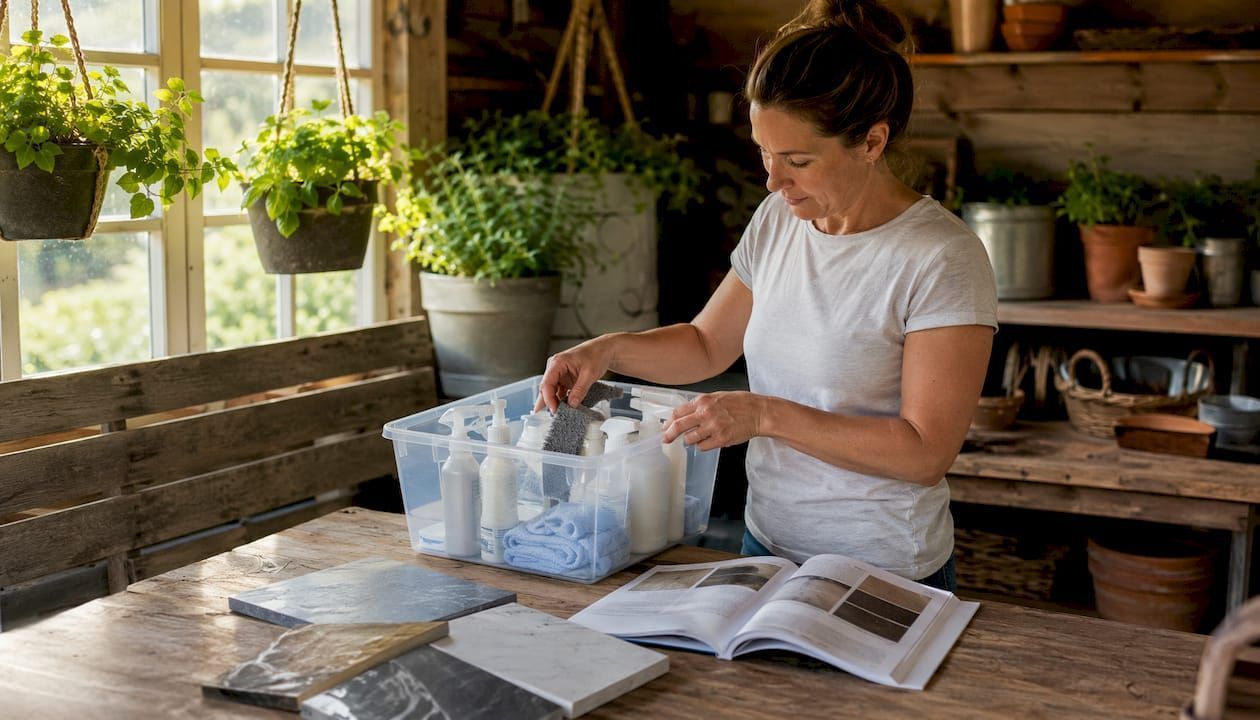
Table of Contents
- What are the stone care must-haves you actually need to buy?
- How do you identify your stone type before buying cleaners?
- What maintenance schedule actually protects natural stone?
- How do you apply a penetrating sealer correctly?
- How do you remove stains from natural stone safely?
- Which tools are safe, and what should you never use on stone?
- How does Oceancarestore cover your stone care checklist?
- Key Takeaways
- Why eco-friendly stone care is worth getting right
- Oceancarestore has a starter kit ready for you
- Useful sources and further reading
What are the stone care must-haves you actually need to buy?
Each product category below does a specific job. Buying the wrong version of any one of them can undo the rest.
- pH-neutral cleaner or mild dish soap concentrate: Look for "pH-neutral," "stone-safe," or "plant-based surfactants" on the label. Mild dish soap works as a practical everyday option when used sparingly and rinsed well. Oceancarestore's pH-neutral stone cleaner and its concentrate version are formulated specifically for this job.
- Penetrating/impregnating sealer: Choose one labeled for your stone type. Topical sealers sit on the surface and peel; impregnating sealers soak in and repel moisture from within.
- Microfiber cloths: At least four. Soft enough to avoid micro-scratches, absorbent enough to blot spills fast.
- Non-treated dry dust mop: Treated mops leave oily residues that attract more dirt. Non-treated is the only safe choice.
- Soft-bristled nylon brush: For grout lines and textured surfaces. Medium-soft bristles only.
- Squeegee: For shower walls and wet vertical surfaces after every use.
- Poultice kit: A paste of absorbent material and solvent to draw deep stains out of porous stone.
- Disposable paper towels: For initial spill blotting when you don't want to contaminate a cloth.
- PPE: Nitrile gloves and safety glasses for any sealer or stain-removal product.
What to look for on the label
| Attribute | Why it matters |
|---|---|
| pH-neutral | Prevents acid or alkali etching on calcareous stones |
| Low-VOC or zero-VOC | Safer for indoor air quality and household members |
| Plant-based surfactants | Biodegradable, gentler on stone and drains |
| Non-abrasive | Protects polished and honed finishes |
| Stone-type guidance | Confirms the product is tested for your specific stone |
Store cleaners and sealers in a cool, dry place with caps tightly sealed. Most liquid stone cleaners stay effective for 2–3 years unopened; sealers typically last 1–2 years once opened. Label every container with the date you opened it.
Pro Tip: Over-applying cleaner leaves a residue film that actually attracts dirt faster. Use far less than the label suggests, then rinse thoroughly. Less is genuinely better here.
How do you identify your stone type before buying cleaners?
Stone type determines everything about which products are safe. Get this wrong and you can etch marble with a cleaner that works fine on granite.
The two geological classes are:
- Calcareous stones (marble, limestone, travertine, onyx): Composed largely of calcium carbonate. Highly sensitive to acids. Even a splash of lemon juice causes immediate etching. The MIA guidance is explicit: use only neutral cleaners and avoid all acidic or abrasive products on these stones.
- Siliceous stones (granite, quartzite, slate, sandstone): Composed mainly of silicates. More resistant to mild acids, but not immune. Certain rust removers contain hydrofluoric acid, which attacks silicates and can damage granite and quartzite — so "more resistant" does not mean "safe with anything."
Simple at-home identification steps
- Check your installer's paperwork or the tile box — stone type is almost always listed.
- Look at the surface: marble and limestone typically show veining or fossil patterns; granite shows a speckled, crystalline grain.
- Run a fingernail across an inconspicuous edge. Marble scratches more easily than granite.
- Do not pour vinegar or any acid on the stone to test it. That test causes the very damage you are trying to prevent.
Once you know your stone class, the buying decision is straightforward: calcareous stones need acid-free cleaners and a sealer rated for porous, calcium-based stone. Siliceous stones have more flexibility but still benefit from pH-neutral products.
What maintenance schedule actually protects natural stone?
Answer first: daily dust-mopping and spill blotting prevent most damage. Everything else is maintenance, not rescue.
- Daily: Dust mop with a non-treated mop. Blot any spills immediately. Squeegee shower walls after every use.
- Weekly: Wet-clean with a pH-neutral solution and a microfiber cloth. Rinse with clean water. Dry the surface.
- Monthly: Inspect grout lines and sealant for cracks or discoloration. Deep-clean if traffic or cooking grease has built up.
- Resealing: High-moisture surfaces like kitchen counters and showers need resealing more often than floors or accent walls. A general starting point is resealing kitchen counters and shower surfaces every 6–12 months, and floors or accent walls every 1–3 years, though your specific stone and sealer brand will narrow that range.
Water-drop test: Drip a few drops of water on the stone surface. If the water beads up, the sealer is holding. If it soaks in and darkens the stone within a few minutes, it is time to reseal. Do this test in a low-traffic corner first.
DIY resealing typically costs $20–$60 in product per average-sized surface. Professional resealing runs $100–$300 or more depending on surface area and stone condition. Hire a pro when the stone shows deep staining, etching, or structural cracking that a sealer alone cannot fix.
How do you apply a penetrating sealer correctly?
Choose a penetrating (impregnating) sealer labeled safe for your stone type. Topical sealers are generally not recommended for most natural stone applications because they sit on the surface and can trap moisture or peel.
- Clean and dry the surface completely. Any moisture or residue under the sealer shortens its life.
- Test a small, hidden area first. Apply a dime-sized amount and let it sit for 10 minutes. Check for discoloration or cloudiness before proceeding.
- Apply with a clean cloth or foam roller in small sections. Work in one direction.
- Let it dwell per the manufacturer's instructions, typically 5–15 minutes.
- Wipe off all excess before it dries. Sealer left on the surface dries cloudy and is difficult to remove.
- Allow full cure time before exposing the surface to water, usually 24–72 hours. Do not rush this step.
- Run the water-drop test after curing to confirm the sealer took.
Sealers increase stain resistance but do not make stone stain-proof. A sealed surface still needs immediate spill response. For common sealer problems and troubleshooting, Oceancarestore's sealer problem guide covers the most frequent mistakes.
Pro Tip: Heavy coats trap residues and cause uneven appearance. Apply thin, even coats and follow the manufacturer's cure time exactly — patience here pays off for years.
How do you remove stains from natural stone safely?
Classify the stain first, then choose the treatment. Applying the wrong product to the wrong stain type can set it permanently.
| Stain type | First-response treatment | Notes |
|---|---|---|
| Oil-based (cooking oil, grease) | pH-neutral cleaner, then poultice with baking soda paste | Blot, don't rub |
| Organic (coffee, tea, food) | pH-neutral cleaner; diluted hydrogen peroxide on light stones | Rinse thoroughly |
| Metal/rust | Poultice with a non-HF rust remover rated for stone | Avoid generic rust removers |
| Biological (mold, mildew) | Diluted stone-safe disinfectant; never bleach on stone | Ventilate the area |
| Ink or paint | Mineral spirits on a cloth for fresh stains; poultice for dried | Test in hidden area first |
| Etch marks | Light re-polishing compound for calcareous stones | May require a pro |
For deep or stubborn stains, a poultice (absorbent powder mixed with the appropriate solvent) is the safest DIY step. Match the solvent to the stain chemistry: acetone for oil, hydrogen peroxide for organic stains. Apply, cover with plastic wrap, let sit 24–48 hours, then remove and rinse.
- Never mix bleach and ammonia. The combination produces toxic chloramine gas.
- Rust removers that contain hydrofluoric acid will damage siliceous stones like granite.
- Call a stone-care professional when a stain persists after two poultice attempts, or when you see deep etching, structural cracking, or surface pitting. Deep rust or permanent etching often requires professional repolishing. You can also explore professional stain removal services to protect your home's value when DIY methods fall short.
Which tools are safe, and what should you never use on stone?
Never use:
- Vinegar, lemon juice, or any acidic cleaner
- Bleach or ammonia-based products
- Abrasive scouring powders or steel wool
- Treated dust mops (leave oily residue)
- Worn vacuum wheels or metal vacuum attachments on soft stones like marble
Sand, dirt, and grit are the primary causes of surface abrasion. Entry mats at every doorway cut the amount of grit that reaches your stone floors significantly.
Safe tools to keep on hand:
- Non-treated dry dust mop
- Soft-bristled nylon brush (medium-soft)
- Microfiber cloths (multiple, color-coded by surface)
- Squeegee for wet vertical surfaces
- Soft plastic scraper for dried debris
Check vacuum attachments before every use. Worn plastic wheels and exposed metal parts scratch soft stones like marble and limestone. Replace or cover any worn parts before running a vacuum near polished stone floors.
For chemical storage: keep sealers and cleaners sealed, away from temperature extremes (below 40°F or above 90°F degrades most formulas), and clearly labeled. Follow basic household chemical safety and keep products out of reach of children.
How does Oceancarestore cover your stone care checklist?
Oceancarestore's product line maps directly to the must-haves above, with an eco-friendly, plant-based, low-VOC focus throughout.
- pH-neutral daily cleaner: The Oceancarestore pH Neutral Tile & Stone Cleaner handles daily and weekly cleaning on marble, granite, travertine, and ceramic. The concentrate version stretches further and works well for property managers maintaining multiple surfaces.
- Penetrating sealer: Oceancarestore Stone & Grout Sealers are impregnating sealers formulated for both calcareous and siliceous stones, with low-VOC credentials for safer indoor application.
- Eco-friendly credentials: Every product in the Oceancarestore line is formulated without harsh acids, with plant-based surfactants where possible, making them safe for households with children, pets, and sensitive indoor air quality concerns.
- Travel and starter kit: The concentrate cleaner in a small container, four microfiber cloths, a poultice pack, and a travel-sized sealer fit in a single tote bag. That covers daily care, emergency stain response, and resealing for a weekend property or rental unit.
For deeper guidance, Oceancarestore's eco-friendly stone maintenance guide walks through a full five-step program for pools, patios, and interior surfaces.
Key Takeaways
Pairing a pH-neutral cleaner with a quality penetrating sealer, a non-treated dust mop, and a poultice kit covers the core of any effective natural stone maintenance routine.
| Point | Details |
|---|---|
| Know your stone type first | Calcareous stones (marble, limestone) are acid-sensitive; siliceous stones (granite, quartzite) are more forgiving but not acid-proof. |
| pH-neutral cleaner is non-negotiable | Vinegar, lemon, bleach, and ammonia cause permanent damage; use only pH-neutral or mild dish soap, rinsed well. |
| Reseal on a schedule | Kitchen counters and shower surfaces need resealing every 6–12 months; floors and accent walls every 1–3 years. Use the water-drop test to check. |
| Dust mop and entry mats prevent most damage | Sand and grit cause surface abrasion; non-treated dust mops and door mats are the simplest protection. |
| Oceancarestore covers the full kit | pH-neutral cleaners, Stone & Grout Sealers, and concentrate options map directly to every item on the must-haves checklist. |
Why eco-friendly stone care is worth getting right
The conventional wisdom says you need a cabinet full of specialty products to maintain natural stone properly. That is not quite right. What you actually need is a short list of the correct products, used with discipline.
Plant-based, low-VOC formulas are not a compromise. When the chemistry is matched to the stone type and applied at the right concentration, they perform on par with harsher alternatives, without the risk of off-gassing in enclosed bathrooms or kitchens, and without the acid or alkali damage that sends homeowners to professional restorers prematurely. The real cost of using the wrong cleaner is not the bottle price. It is the repolishing bill, or the slab replacement.
Oceancarestore's authored guides, written by Cee, are built around this principle: that the safest product for your household is usually also the safest product for your stone. The sustainable surface care tips on the site expand on this for homeowners who want to go deeper.
Oceancarestore has a starter kit ready for you
If you want to skip the research and get straight to protecting your stone, Oceancarestore's product range covers every item on the checklist above: pH-neutral cleaners, Stone & Grout Sealers, and concentrate formulas that work for single-home owners and property managers alike. The products are plant-based, low-VOC, and formulated to be safe on calcareous and siliceous stones without the guesswork of mixing household chemicals.
For pool-adjacent stone and outdoor surfaces, the pool tile maintenance range extends the same eco-friendly approach to calcium buildup and waterline staining. Always test any new product on a small, hidden area first. Browse the full product range at Oceancarestore and pick the cleaner and sealer matched to your stone type.
Useful sources and further reading
The checklist and guidance in this article draw from these primary sources:
- Natural Stone Institute — Consumer Care Guidance: The industry's primary authority on cleaning, sealing, and damage prevention for all natural stone types.
- Marble Institute of America (MIA) — Care & Cleaning Guide: Specific guidance on calcareous stones and the case against acids and abrasives.
- Wirecutter — How to Clean Marble, Granite, and Limestone: Practical consumer-facing guidance on everyday cleaners and resealing frequency.
- Art Stone Restoration: For deep etching, structural damage, or professional repolishing beyond DIY scope.
For daily care routines and kitchen-specific steps, Oceancarestore's kitchen stone cleaning guide and outdoor stone maintenance guide are practical next reads. For structural damage or stains that do not respond to two rounds of poultice treatment, consult a certified stone-care professional.

