
Why Tile Grout Darkens in Commercial Spaces
TL;DR:
- Tile grout darkens because porous joints absorb minerals, organic soils, and microbial growth, accelerating with traffic wear. Regular extraction cleaning and sealing are essential to prevent deep staining and health inspection violations in commercial spaces. When stains persist after cleaning, regrouting or recoloring may be necessary, and proper maintenance safeguards long-term grout health.
Tile grout darkens in commercial spaces because porous grout absorbs minerals, organic soils, microbial growth, and cleaning residues — and once micro-cracks form from traffic wear, re-soiling accelerates sharply. The Tile Council of North America links improper maintenance directly to accelerated discoloration, health-inspection guidance flags stained or cracked grout as a potential violation in food service facilities, and Oceancarestore's product line addresses each stage of the problem. Your single highest-priority action this week: schedule a deep alkaline degreaser pass with mechanical agitation and extraction before considering any more invasive fix.
- Grout is porous and recessed — it absorbs whatever hits it
- Mineral deposits, grease, soap film, and microbial growth all compound over time
- Cleaning mistakes (acidic products, dirty mop water) accelerate the damage
- Extraction-based cleaning outperforms mopping for embedded staining
- Sealing after restoration is what keeps grout lighter longer
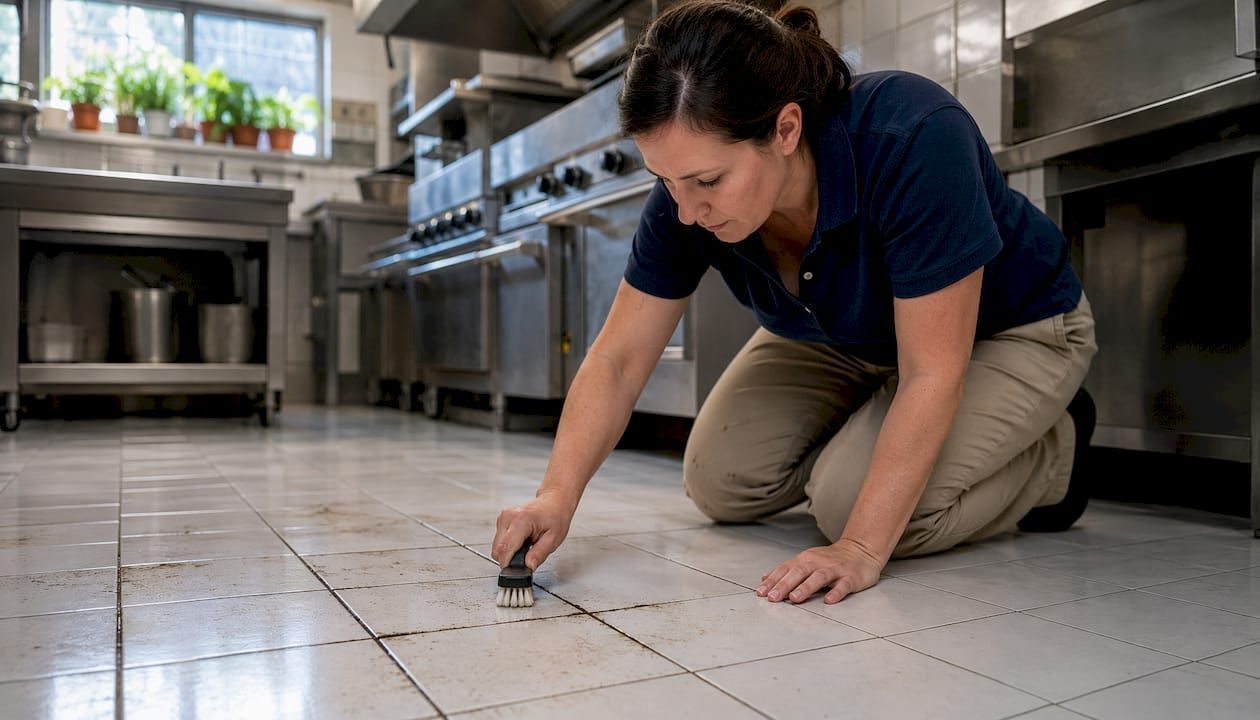
Table of Contents
- Why tile grout darkens in commercial spaces: the direct causes
- How grout darkening develops — and when you are already behind
- Health inspection and liability risk for food service facilities
- Step-by-step restoration for deep grout staining
- Prevention: sealing strategies and a maintenance schedule
- When deep cleaning won't fix it: recolor or replace
- Choosing cleaners and sealers that balance effectiveness and safety
- How Oceancarestore products fit a commercial restoration workflow
- Key Takeaways
- The part most facility managers get wrong
- Oceancarestore has the products your specification needs
- Useful sources for facility teams
Why tile grout darkens in commercial spaces: the direct causes
Facility teams usually see the symptom before they understand the cause. Here is what is actually happening at each location on your floor plan.
- Hard-water mineral deposits. Calcium and magnesium left behind after water evaporation bond with dirt and soap film in grout pores, creating dark, uneven residue that gets harder to remove with every passing month. Entrance vestibules and restrooms near hard-water supply lines show this first.
- Organic soils: grease, oils, and food residue. Grout in kitchens and service corridors absorbs grease the way a sponge absorbs water. A mop pass moves it around; it does not pull it back out. Grease soaks into cementitious grout and bonds at the pore level.
- Microbial staining. Mold and mildew thrive in recessed grout joints where moisture lingers. Restroom grout turns dark from the combination of moisture, soap residue, and foot traffic — even when cleaned regularly.
- Wear and abrasion. Heavy foot traffic grinds grit into the grout surface, creating micro-cracks that increase porosity. More porosity means faster staining on the next cycle.
- Cleaning mistakes. Acidic cleaners (vinegar, muriatic acid) etch cementitious grout and leave pitting that stains faster going forward. Dirty mop water pushes soil deeper into joints rather than removing it. Both mistakes are common and both make the problem worse.
How grout darkening develops — and when you are already behind
The mechanics start immediately. Every time foot traffic brings in soil and water evaporates, minerals and organics are left behind in the pores. In the first few weeks, routine mopping keeps the surface looking acceptable. Within a few months in a high-traffic zone, the buildup resists mopping entirely.
Medium-term, you start seeing "traffic lanes" — darker paths that trace the heaviest foot patterns. Surface haze appears in areas with hard water. After seasonal spikes (winter road salt tracked in, heavy grease seasons in kitchens), the darkening accelerates noticeably. Routine mopping cannot remove embedded soils at this stage.
Long-term, micro-cracking sets in. If staining returns rapidly after a deep clean, the Tile Council of North America points to substrate moisture (efflorescence) as a possible root cause — meaning the moisture barrier under the slab may need investigation, not just the grout surface. High humidity above 60% and temperature swings accelerate micro-cracking further, which is why climate control in a facility is part of grout health, not just the cleaning regimen.
Health inspection and liability risk for food service facilities
Stained or cracked grout is not just an aesthetic problem in a restaurant or commercial kitchen. Health inspectors flag it as a harborage point for bacteria and food particles — a potential violation that can trigger a failed inspection or a required corrective action.
- Document every deep clean. Keep dated service records showing the chemical used, the method, and who performed the work. Inspectors ask for this.
- Maintain sealer application records. Note the product name, application date, and the product's SDS. This demonstrates a proactive maintenance program.
- Repair cracked joints before the inspection. A cracked joint is a more serious violation than a stained one. Prioritize structural repair over cosmetic cleaning when both are needed.
- Schedule spot checks between professional cleans. Walk the kitchen and restroom floors monthly. Flag any new cracking, grout loss, or persistent dark patches for immediate attention.
- Use the right chemistry. Cleaning agents that drive grout discoloration through improper pH can make staining worse and leave residues inspectors will notice.
Step-by-step restoration for deep grout staining
Follow this sequence whether your crew is doing the work or you are writing a scope for a contractor.
- Assess the grout type and condition. Epoxy grout and cementitious grout respond differently to chemistry. Check for efflorescence (white haze), structural cracking, or joint loss before choosing a method.
- Pre-sweep the floor. Remove all loose grit before running any scrubber. Grit under a brush scratches tile and redeposits soil.
- Apply an alkaline degreaser at pH 10–13. This is the right chemistry for organic and grease-based staining. Let it dwell 5–10 minutes so it penetrates the pores before agitation.
- Agitate with a stiff-bristle brush or floor scrubber. Flat pads ride over recessed grout lines. A brush reaches into the joint. For large areas, a commercial floor scrubber with a brush attachment covers ground efficiently.
- Extract the spent solution immediately. Do not let dirty solution dry on the surface — it redeposits the soil you just loosened. A wet vacuum or scrubber with a squeegee pickup pulls contaminants out rather than moving them around. This is why extraction beats mopping at this stage.
- Rinse and inspect. Check whether the staining has lifted. Repeat the chemical-agitation-extraction cycle if needed.
- Reserve mild acids for mineral-specific stains only. After testing on an inconspicuous area, a dilute acid treatment can address calcium deposits — but never use muriatic acid or vinegar on cementitious grout as a general cleaner.
Safety and equipment: PPE (gloves, eye protection, non-slip footwear), SDS on hand for every chemical, floor scrubber with brush attachment, wet vacuum or extraction unit, stiff hand brushes for edges and corners. Document the SDS for your crew records.
Pro Tip: For a detailed acid-free restoration protocol, Oceancarestore's guide on deep-cleaning grout without harsh acids walks through the full chemical and mechanical sequence.
Prevention: sealing strategies and a maintenance schedule
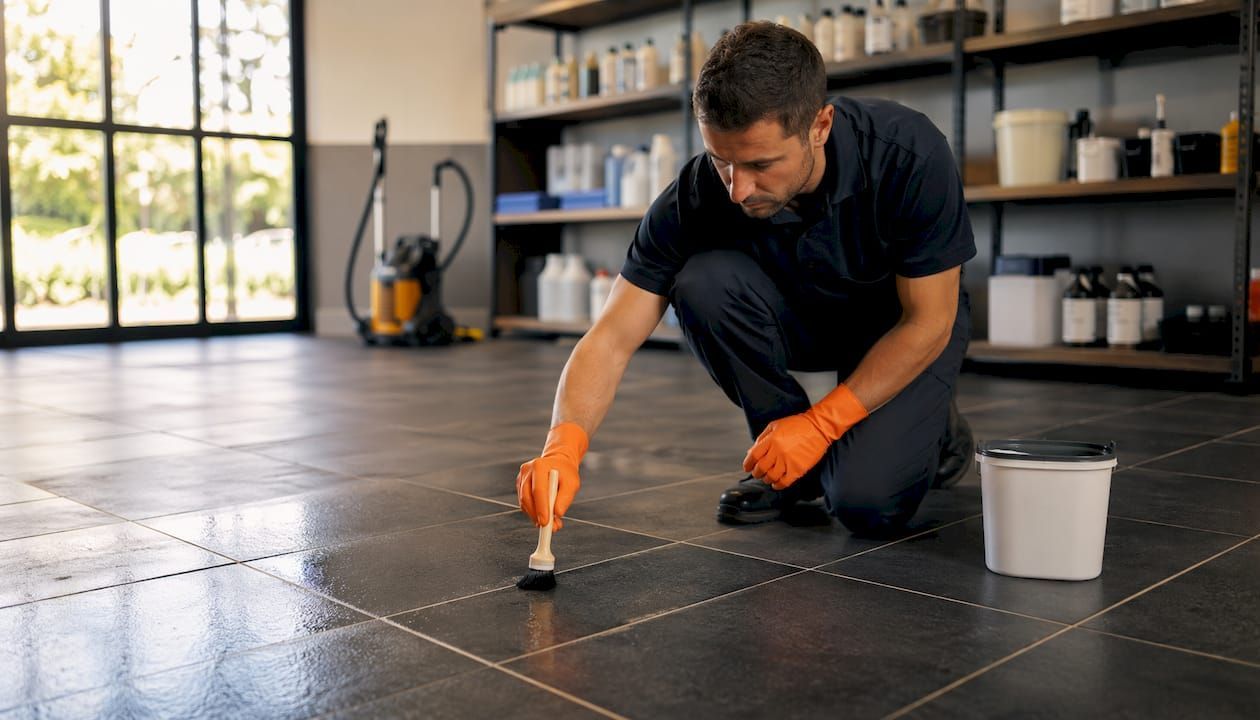
Cleaning gets grout back to baseline. Sealing is what keeps it there. The two sealer types serve different situations.
| Dimension | Penetrating sealer | Color/fill sealer |
|---|---|---|
| Durability | Moderate; recoat every 1–2 years | High; lasts 3–5 years in heavy traffic |
| Appearance | Preserves original grout color | Uniform, refreshed color |
| Recoat frequency | Annual in high-traffic zones | Every 3–5 years |
| Cost shape | Lower upfront | Higher upfront, lower long-term |
| Best use case | Kitchens, restrooms, general floors | High-traffic entries, aged or stained grout |
A practical maintenance cadence for commercial facilities:
- Daily: Dry sweep or auto-scrub with clean water to remove surface grit and spills before they set.
- Quarterly: Deep clean high-traffic zones with an alkaline degreaser and mechanical agitation. Restaurants and food service kitchens warrant monthly deep cleans given grease load.
- Semiannual or annual: Professional deep clean plus reseal, timed to traffic patterns. Trigger a reseal when water no longer beads on the grout surface after cleaning.
Sealing after restoration is the single most cost-effective investment in grout longevity. Grout in high-moisture zones reabsorbs soils quickly without a sealer barrier. For more on why sealing matters, Oceancarestore covers the full case in 9 reasons to seal grout. Common sealer application errors are worth reviewing before your crew starts — see mistakes to avoid when applying grout sealers.
When deep cleaning won't fix it: recolor or replace
Two restoration passes with proper chemistry and extraction should lift most embedded staining. If they do not, the decision tree shifts.
- Recoloring (color sealer) works when the grout joint is structurally intact but permanently stained. It is cost-effective, can be done without downtime for tile removal, and delivers a uniform appearance. Ballpark cost for professional color sealing runs in the range of $1–$3 per square foot depending on prep and area size, though local contractor rates vary.
- Full regrout is warranted when joints are cracked, missing, or when substrate moisture is the root cause. Expect higher cost, more downtime, and a prep requirement (old grout removal). Ballpark ranges for professional regrout start around $5–$15 per square foot.
- Decision checklist: persistent staining after two full restoration passes; visible structural cracking or joint loss; efflorescence returning within weeks of cleaning; aesthetic goals that require a color change.
When specifying work to a contractor, require a test patch before full-area treatment and ask for a written warranty on materials and labor.
Choosing cleaners and sealers that balance effectiveness and safety
The pH of your cleaner determines what it removes and what it damages.
- Alkaline degreasers (pH 10–13): correct choice for organic soils, grease, and soap film. Safe on cementitious and epoxy grout when used per dilution instructions.
- Acids (low pH): reserve for mineral-specific deposits (calcium scale) after testing. Never use on cementitious grout as a routine cleaner — acids pit the surface and accelerate future staining.
- Neutral cleaners: appropriate for daily maintenance between deep cleans, particularly in epoxy-grouted commercial kitchens where no-rinse practices concentrate oleic acid and can degrade even epoxy grout over time.
Worker safety checklist: gloves and eye protection for all chemical applications; adequate ventilation, especially in enclosed restrooms; SDS posted or accessible for every product in use; full rinse and neutralization steps after acid treatments; wet floor signage throughout.
For environmental and VOC considerations, low-VOC and biodegradable cleaner and sealer categories are available and perform well in commercial settings. Oceancarestore's eco-friendly grout restoration guide covers plant-based options that meet both performance and sustainability goals. Dispose of spent cleaning solution per local hazardous-waste guidelines; check your municipality's requirements for alkaline or acid-containing wastewater.
Pro Tip: Temperature and humidity affect grout health as much as cleaning frequency. Facilities with humidity consistently above 60% or significant seasonal temperature swings should factor climate control into their maintenance budget — and consider how substrate moisture affects pool and hard-surface longevity in adjacent outdoor areas.
How Oceancarestore products fit a commercial restoration workflow
The workflow is always the same: clean, extract, inspect, then seal or recolor. Oceancarestore's product categories map directly to each step.
- Clean: Commercial alkaline degreaser or the biodegradable grout haze remover and cleaner for organic soils and surface haze. For calcium and mineral deposits, the calcium remover category handles what alkaline chemistry alone cannot.
- Extract: After agitation, pull spent solution with a wet vacuum or floor scrubber with extraction. Never let it dry.
- Inspect: Check for re-soiling within 48 hours. Rapid re-darkening points to a sealer gap or substrate moisture issue.
- Seal or recolor: Apply a penetrating sealer for general protection or a color sealer for high-traffic entries and permanently stained joints. The stone and grout sealer category covers both options with low-VOC formulations.
When writing a contractor scope, request the product TDS (technical data sheet), VOC rating, and cure time for every product specified. Oceancarestore provides SDS documentation for its product line — request it at checkout or through the product pages for your procurement records.
Key Takeaways
Tile grout darkens in commercial spaces because porous joints absorb minerals, organic soils, and microbial growth faster than routine mopping can remove them, and the damage compounds without sealing.
| Point | Details |
|---|---|
| Schedule extraction-based cleaning now | Alkaline degreasers at pH 10–13 with mechanical agitation and extraction outperform mopping for embedded staining. |
| Seal after every deep clean | Grout in high-moisture zones reabsorbs soils quickly; sealing after restoration is the most cost-effective protection step. |
| Cracked grout is an inspection risk | Health inspectors flag cracked or stained grout in food service facilities as a harborage violation — repair before the next inspection. |
| Know when to recolor vs. replace | Persistent staining after two restoration passes, structural cracking, or returning efflorescence signals regrout, not another cleaning cycle. |
| Use Oceancarestore for the full workflow | Oceancarestore's cleaners, calcium removers, and low-VOC sealers cover every step from initial deep clean to long-term grout protection. |
The part most facility managers get wrong
The conventional wisdom in commercial floor care is that grout darkening is a cleaning problem. Schedule more frequent mops, use a stronger cleaner, done. That framing is wrong in a specific and costly way.
Mopping is a surface intervention. Grout is a subsurface problem. By the time grout looks dark, the soil is embedded in the pore structure — and pushing more mop water over it, especially dirty mop water, drives the contamination deeper. The managers who get ahead of this problem are not the ones who mop more often. They are the ones who treat cleaning and sealing as a single system, not two separate tasks.
The other thing most facilities underestimate is the inspection exposure. A stained grout line in a dining room is an aesthetic issue. A cracked grout joint in a prep kitchen is a documented harborage point. Those are not the same problem, and they do not get the same response from an inspector. Knowing the difference — and having the service records to prove you acted on it — is what separates a corrective action from a passed inspection.
Oceancarestore has the products your specification needs
Facility managers writing a maintenance spec or procurement order for grout restoration need products that perform, carry SDS documentation, and meet sustainability requirements. Oceancarestore's commercial-grade cleaners, calcium removers, and low-VOC penetrating and color sealers cover the full workflow from initial deep clean through long-term protection.
A standard restoration kit starts with an alkaline cleaner or biodegradable haze remover, moves through mechanical extraction, and finishes with a penetrating or color sealer matched to your traffic level. Every product comes with SDS documentation for your inspection and contractor records. Browse the full tile maintenance range and get the spec-ready product details your procurement team needs at Oceancarestore's tile maintenance page.
Useful sources for facility teams
- Tile Council of North America — White Residue FAQ — Technical guidance on efflorescence and substrate moisture; show this to contractors investigating recurring staining. Technical authority.
- Health Inspection Guidance: Restaurant Kitchen Tile Mistakes — Specific inspection failure points for food service facilities. Show to your operations team before the next inspection.
- Commercial Grout Cleaning: What Professionals Use — Chemistry and equipment guidance for deep restoration. Technical reference for scope-writing.
- Why Mopping Isn't Enough — Explains the limits of routine mopping and the case for periodic professional cleaning. Useful for justifying budget to stakeholders.
- Grouting Commercial Kitchens (MAPEI) — Industry technical document on epoxy grout selection and oleic acid degradation in food service. Vendor resource; useful for kitchen-specific specification.
- Oceancarestore Stone and Grout Sealers — Product category page with low-VOC sealer options and SDS links. Vendor resource.
- Oceancarestore Grout Protection Ideas — Practical maintenance guidance for property managers. Vendor resource.

