
Surface Protection Explained: Eco-Friendly Solutions
TL;DR:
- Surface protection creates a waterproof barrier that prevents deep-seated water damage and staining.
- Penetrating sealers, especially eco-friendly polysiloxane-based types, offer long-lasting, invisible defense.
- Proper surface cleaning, drying, and application are essential for effective and durable sealing results.
Most homeowners focus on cleaning the surface they can see, but deterioration almost always starts below it. Water seeps into microscopic pores, freeze-thaw cycles crack stone from within, and stains set deep before they're ever visible. What's striking is how advanced modern protection has become. Polysiloxane sealers penetrate up to 12.3mm into stone and reduce water absorption to just 0.38%, numbers that would have seemed impossible with older products. Today's eco-friendly formulas match that performance without harsh chemicals. This guide breaks down exactly how surface protection works, what products to choose, and how to apply them correctly.

Table of Contents
- What is surface protection and why does it matter?
- Types of surface protection: Sealers, coatings, and eco-friendly innovations
- How penetration and water resistance work: The new science behind sealers
- Practical application: Steps, mistakes to avoid, and eco tips
- What most people get wrong about surface protection
- Take the next step: Trusted eco-friendly surface protection products
- Frequently asked questions
Key Takeaways
| Point | Details |
|---|---|
| Deep penetration matters | Sealers that penetrate deeply, like polysiloxane, offer superior long-term surface protection. |
| Eco solutions deliver | Modern eco-friendly products now rival traditional sealers in protecting tile and stone. |
| Proper application key | Maximizing performance relies on thorough prep and correct sealer use every time. |
| Understand product types | Penetrating sealers and coatings protect differently, so choose based on long-term needs. |
What is surface protection and why does it matter?
Surface protection is the practice of sealing or treating hard surfaces like natural stone, pool tile, and grout to resist water, stains, and physical wear. It's not just cosmetic. Without a proper barrier, water enters the pores of unprotected stone and tile constantly, carrying mineral deposits, oils, and contaminants with it. Over time, that moisture causes internal cracking, efflorescence (white mineral blooms on the surface), and permanent staining.
The risks compound quickly:
- Water damage: Absorbed moisture weakens the internal structure of stone and grout, leading to cracking and spalling.
- Staining: Porous surfaces pull in oils, rust, algae, and calcium deposits with no way to flush them out easily.
- Biological growth: Algae and mold thrive in wet, porous environments, especially in pools and outdoor spaces.
- Costly repairs: Replacing damaged stone or re-grouting pool tiles can cost thousands. Prevention is significantly cheaper.
The role of a quality sealer is to create a hydrophobic barrier, meaning water beads off instead of soaking in. Hydrophobic sealers like those based on polysiloxane chemistry work by penetrating 12.3mm deep and lining the internal pores with a water-repellent layer. The stone looks unchanged, but water simply can't get in.
"The best surface protection is the kind you never notice—because nothing is going wrong."
Eco-friendly formulas take this further by achieving these results without volatile organic compounds (VOCs), harsh acids, or synthetic solvents. If you're not sure why seal natural stone matters as a starting point, that foundational understanding will change how you maintain every stone surface in your home or property.
Eco-conscious formulas are not a compromise. In many cases, plant-derived and low-VOC sealers are gentler on the substrate (the surface being treated) while still providing professional-grade water resistance. They're also safer for children, pets, and the environment around your pool or outdoor living space.
Types of surface protection: Sealers, coatings, and eco-friendly innovations
Not all protectors work the same way, and choosing the wrong type can mean re-doing the job in under a year. The main categories are penetrating sealers, film-forming coatings, and the newer generation of eco-friendly formulations.
Penetrating sealers bond chemically within the stone itself. They don't change the look of the surface, don't peel or flake, and can last years before needing reapplication. Polysiloxane-based sealers are the gold standard here, offering measurable penetration depth and reduced water uptake that outperforms most alternatives.
Film-forming coatings sit on top of the surface and create a visible layer. They can enhance color or add gloss, which some homeowners prefer. But they wear down with foot traffic, UV exposure, and pool chemicals, meaning they need more frequent maintenance.
| Feature | Penetrating sealer | Film-forming coating |
|---|---|---|
| Appearance change | None | Visible sheen or gloss |
| Durability | 3 to 5+ years | 6 to 12 months |
| Peel or flake risk | None | Yes, with wear |
| Eco-friendly options | Widely available | Limited |
| Best for | Stone, tile, grout | Decorative concrete, pavers |
Eco-friendly innovations fall across both categories, but they shine brightest in penetrating sealers. Look for these features on the label:
- Low or zero VOC content
- Biodegradable formula
- Plant-derived or water-based carrier
- Acid-free and non-toxic ingredients
Pro Tip: Just because a product says "natural" doesn't mean it provides lasting hydrophobic protection. Always check for actual performance data, particularly water absorption test results, before buying. You can explore eco-friendly stone cleaners as a starting point for understanding what real green performance looks like.
Most homeowners focus on cleaning the surface they can see, but deterioration almost always starts below it. Water seeps into microscopic pores, freeze-thaw cycles crack stone from within, and stains set deep before they're ever visible. What's striking is how advanced modern protection has become. Polysiloxane sealers penetrate up to 12.3mm into stone and reduce water absorption to just 0.38%, numbers that would have seemed impossible with older products. Today's eco-friendly formulas match that performance without harsh chemicals. This guide breaks down exactly how surface protection works, what products to choose, and how to apply them correctly.
For homeowners who want both deep protection and eco responsibility, products like a high performance penetrating sealer bridge that gap effectively. Some formulas also clean and seal in one step, which saves time on pool tile or high-traffic stone areas.
How penetration and water resistance work: The new science behind sealers
The two numbers that matter most when evaluating any sealer are penetration depth and water absorption rate. Everything else is secondary.
Penetration depth tells you how far the active ingredients travel into the stone. A shallow sealer only protects the very top layer, which wears away quickly. A deep-penetrating sealer protects the structure of the stone from the inside, where water actually causes damage.
Water absorption rate tells you how much moisture the treated surface can still absorb. Lower is always better. Polysiloxane sealers reach 12.3mm deep, reducing water absorption to 0.38%. For reference, untreated stone often absorbs 5% to 12% of its own weight in water. That difference is the margin between a surface that lasts decades and one that starts cracking within years.
Key performance metrics to understand:
- Penetration depth (mm): Higher numbers mean better structural protection. Aim for sealers that penetrate at least 8mm, with 12mm or more being ideal.
- Water absorption (%): Look for post-treatment absorption below 1%. Anything above 2% means the sealer is mostly surface-level.
- VOC level (g/L): Eco-friendly products typically fall below 50 g/L. Some water-based options measure near zero.
- Cure time (hours): Faster cure times reduce the window for contamination during application.
The 0.38% water absorption figure from polysiloxane testing isn't just a data point. It represents a surface that is, for practical purposes, waterproof.
Application method also affects how well those numbers translate to real-world results. You can explore sustainable protection for stone to find formulas that combine science-backed performance with environmental responsibility. And if you want to understand exactly how the chemistry prevents discoloration, the guide on how to prevent tile stains naturally adds practical context.
Practical application: Steps, mistakes to avoid, and eco tips
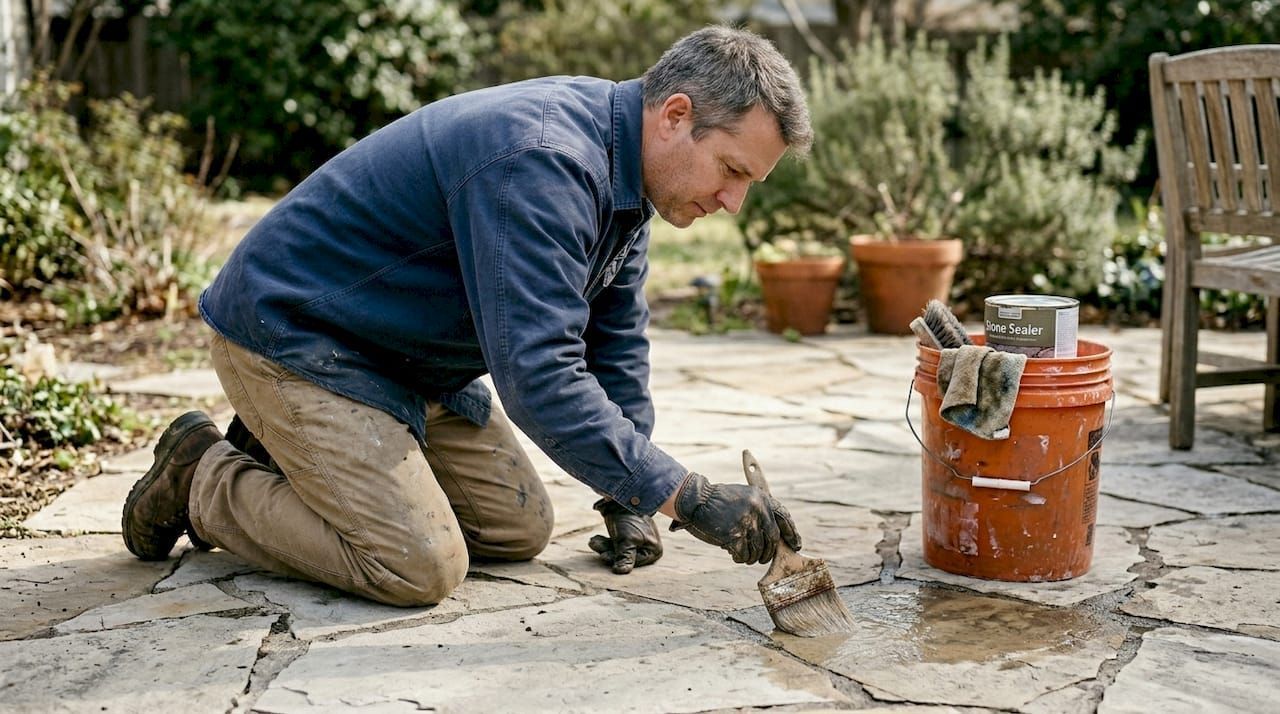
Knowing which sealer to use is half the battle. Applying it correctly is what actually determines whether it works. Improper methods reduce water resistance significantly, no matter how advanced the formula. Proper application is what allows deep-penetrating sealers to reach their rated performance.
Step-by-step application process:
- Clean the surface thoroughly. Use a biodegradable cleaner to remove all dirt, calcium deposits, grease, and old sealer residue. Any contamination blocks penetration.
- Let the surface dry completely. Moisture in the pores competes with the sealer and prevents it from bonding. Wait at least 24 to 48 hours after cleaning, or longer in humid climates.
- Apply in small, manageable sections. Work in 3 to 4 square foot sections to ensure even coverage before the sealer begins to absorb.
- Wipe away excess promptly. Any sealer left on the surface after absorption can leave a hazy residue. Wipe within the product's open time window.
- Allow full cure time. Follow the manufacturer's instructions. Most penetrating sealers need 24 to 72 hours before exposure to water.
Not sure whether your surface needs cleaning or sealing first? The guide on cleaner vs sealer covers that decision clearly.
Common mistakes that compromise results:
- Applying sealer to a damp or wet surface
- Using a cleaner that leaves a residue incompatible with the sealer
- Applying too much product at once, expecting more coverage to mean more protection
- Skipping the cure window and letting water contact the surface too early
Pro Tip: Always do a small test patch in an inconspicuous area first, especially on natural stone. This confirms compatibility and gives you a preview of the finished look before committing to the full surface.
For eco-conscious application, use plant-based or biodegradable prep cleaners and ventilate indoor spaces during application. Resources on choosing the right stone sealer and common problems with stone sealers can save you from the most frequent and costly errors.
What most people get wrong about surface protection
After working in surface care, one pattern stands out clearly. Most people treat sealers as a finishing touch, something applied after restoration is complete, like a coat of polish. That framing is wrong, and it leads to repeated failures.
Sealers are structural protection, not decoration. The moment you understand that, every decision changes. You stop skipping prep. You stop buying the cheapest product on the shelf. You stop applying it once and forgetting it for a decade.
The other misconception is that eco-friendly means weaker. That idea is outdated. Science-backed products now demonstrate that low-VOC, plant-derived formulations can match or exceed traditional chemical sealers in penetration and water resistance. The data is there. The products exist.
What damages most surfaces isn't time or weather alone. It's the gap between what people think they did and what actually happened at the application stage. Reading about why sealing matters is a good start, but committing to proper prep, compatible products, and correct technique is what separates surfaces that last from ones that don't.
Take the next step: Trusted eco-friendly surface protection products
You now understand what surface protection actually does, why penetration depth and water resistance are the metrics that matter, and how to apply sealers correctly. The final piece is finding products built around the same science.
At
Oceancare Store, our focus is on
pool tile maintenance solutions and
stone and grout sealers that deliver real performance without compromising on environmental responsibility. Every product is selected to be low-VOC, biodegradable where possible, and effective on the surfaces that matter most to homeowners and property managers. Explore our range of
eco-friendly surface cleaners and find the right solution for your specific surface, whether it's pool tile, outdoor stone, or interior natural stone flooring.
Frequently asked questions
What is the difference between a penetrating sealer and a coating?
A penetrating sealer bonds inside the stone's pores for invisible, long-lasting protection, while a coating forms a visible layer on top that wears faster. Polysiloxane penetrates 12.3mm for structural protection that coatings simply can't match.
How long does a good surface protector last on pool tile or stone?
High-quality penetrating sealers typically last 3 to 5 years or more, while coatings usually need renewal every 6 to 12 months. Penetrating sealers provide deep, lasting hydrophobicity that holds up to pool chemicals, UV, and heavy use.
Are eco-friendly sealers as effective as traditional ones?
Yes. Modern eco-friendly formulas, especially polysiloxane-based ones, can match or outperform traditional chemical sealers. Polysiloxane-based products deliver superior penetration and water resistance while staying low-VOC and environmentally safe.
What mistakes reduce the effectiveness of surface protection?
Applying sealer to a damp surface, skipping a proper clean, or using incompatible cleaners will all undermine performance. Proper application is essential to reach the water resistance ratings that make quality sealers worth using.
Can these products be used indoors and outdoors?
Yes, most penetrating and eco-friendly sealers work on both indoor and outdoor stone and tile surfaces, from kitchen countertops to pool surrounds. Always confirm the product label specifies the surfaces you're treating before applying.
Recommended
- Eco-Friendly Cleaning: Safer Solutions for Surface Care
- 7 Hard Surface Cleaning Best Practices for Eco Homes
- Natural Stone Sealers: Protecting Surfaces Sustainably
- How to Prevent Tile Stains Naturally (Eco-Friendly)
- Expert Painting Tips and Trends | Johnny's Custom Painting Blog
- 6 Leading Advantages of Eco-Friendly Cleaning for Offices

