
Make Sealed Tile Safer: Eco Fixes to Meet DCOF 0.42 for Homeowners
The fastest safe way to reduce slips on sealed tile is to mitigate the hazard immediately with drying, non-slip mats, or traction strips, then apply a matched long-term treatment after testing a small area. Longer term, that usually means an anti-slip coating or light mechanical texturing followed by an appropriate reseal. Test first with a simple water-bead check or a professional DCOF measurement, and lean toward eco-friendly products when the tile sits near a pool, kitchen, or bathroom.
TL;DR:
- Immediate mitigation involves drying and placing non-slip mats or traction strips before testing and applying permanent anti-slip solutions.
- Conduct surface tests, such as water-bead checks or DCOF measurements, to determine slip resistance before choosing a treatment.
- Topical coatings and micro-texturing are suitable for glazed tiles, while natural stone often requires only cleaning and resealing to improve grip.
- Residue buildup from soap and minerals often causes slipperiness on sealed tile, making proper cleaning essential for safety.
- Professional assessment and treatment are recommended for widespread or repeated slip incidents, especially on sensitive or high-traffic surfaces.
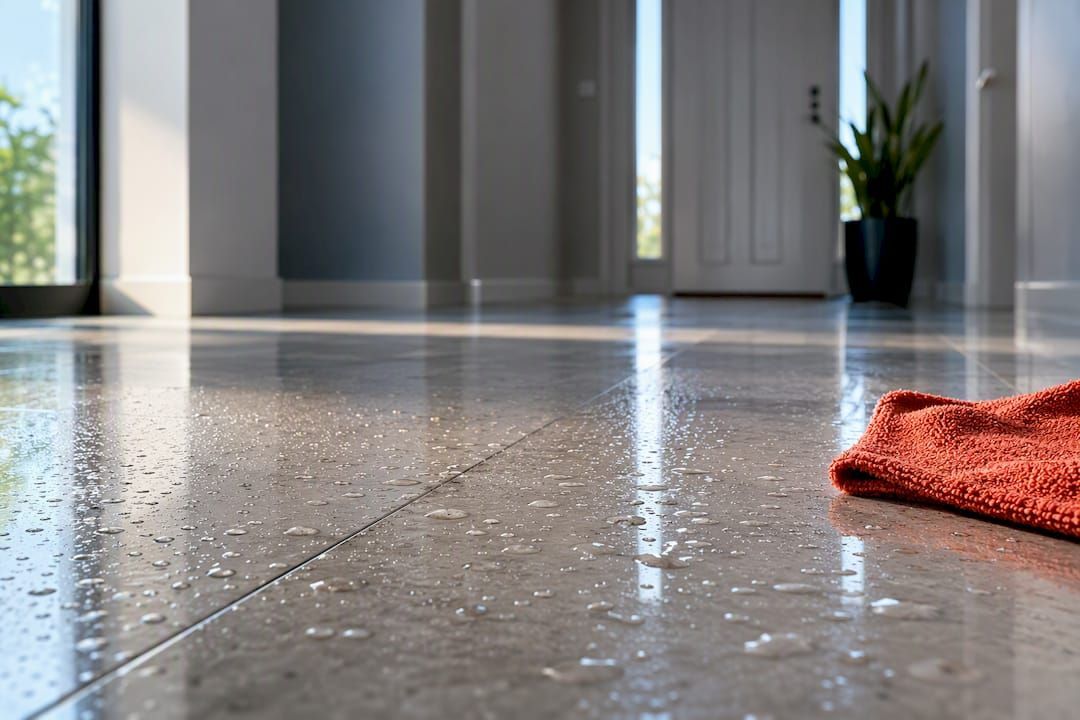
Table of Contents
- Quick, temporary fixes you can do today
- Permanent treatments for sealed tile: what works and what to avoid
- How to test slipperiness and pick the right treatment
- Cleaning and maintenance practices that reduce slipperiness on sealed tile
- When to call a pro and a short safety checklist
- Eco-friendly product guidance and safe application
- Why sealed tile turns slippery in the first place
- Safety standards and regulations relevant to floor slipperiness
- Long-term durability and how anti-slip treatments affect tile appearance
- Potential effects on tile warranty or resale value
- Balancing safety, durability, and appearance
- How Oceancare Store can help with your next step
- Sources
- FAQ
Quick, temporary fixes you can do today
Standing water is often the real problem, not the tile itself. Improving airflow and drainage around showers, entryways, and pool decks dries the surface faster and cuts down the window when tile is genuinely dangerous.
While you plan a permanent fix, a few temporary measures buy you safety without altering the tile:
- Place non-slip bath mats or rugs with rubber, non-skid backing in high-risk zones like tub exits and kitchen sinks.
- Add rubber shower treads or adhesive anti-slip strips directly on the tile where water pools most.
- Improve ventilation and fix drainage slopes so water clears the surface instead of sitting on it.
- Restrict access to a particularly hazardous area with a small barrier until a permanent treatment is applied.
Adhesive strips work best on flat, clean, glazed tile and hold poorly on textured or uneven natural stone. Mats and rugs can themselves become trip hazards if they curl or slide, and any rubber-backed product left down too long can trap moisture and encourage mold. Treat these as bridges, not destinations.
Pro Tip: Test any adhesive strip or mat on a small, low-visibility patch for a day before committing to a whole room, since some adhesives react differently with sealed grout lines.
Permanent treatments for sealed tile: what works and what to avoid
Once the immediate risk is handled, the goal shifts to a fix that lasts through years of foot traffic and cleaning. Three approaches dominate for sealed tile, and each fits a different situation.
- Topical anti-slip coatings and additives. These add microscopic texture to the surface without stripping the existing sealer, making them the least invasive option for glazed ceramic and porcelain.
- Mechanical texturing followed by a reseal. Light abrasion or micro-sanding roughens the surface at a controlled scale, then a fresh sealer locks in protection. This suits durable glazed tile and porcelain well but is riskier on soft or polished natural stone, where abrasion can dull the finish permanently.
- Chemical etching. Acid-based etching can open up texture quickly, but it reacts unpredictably with sensitive stone like marble or limestone and can strip or damage an existing sealer, so it's rarely the first choice for sealed installations.
The tile type and finish should drive the decision. Glazed, high-gloss tile in a shower or entry benefits most from a topcoat, since gloss itself is a major contributor to slipperiness. Textured natural stone often needs nothing more than the right cleaner and periodic resealing, since it already carries some grip. High-traffic commercial floors may justify mechanical texturing paired with a professional reseal to hold up over years of use.
Whichever route you pick, research on surface roughness found that slip resistance improves within specific roughness ranges under soapy and oily conditions, and that pushing roughness beyond those ranges brings diminishing returns and makes the surface harder to clean. That's the practical argument for patch testing before treating an entire floor: too little texture leaves the hazard unsolved, and too much creates a grime trap that eventually becomes its own slip risk.
How to test slipperiness and pick the right treatment
Guessing at slipperiness wastes money on the wrong fix. The tile industry uses a measurable standard, and homeowners have a rough, low-cost equivalent.
ANSI A326.3 requires manufacturers to classify hard-surface flooring into five product-use categories: ID (interior dry), IW (interior wet), IW+ (interior wet, higher demand), EW (exterior wet), and O/G (outdoor/garage). These categories help match a tile or treatment to where it will actually be walked on wet.
- Check the product's technical data sheet for its A326.3 classification before choosing a coating or reseal product.
- Run a simple water-bead test: pour a small amount of water on the tile and see how it beads versus spreads, since flatter spreading often signals a smoother, slicker surface.
- Do a barefoot or sock-footed safe-walk test on wet tile in a controlled setting to get a feel for real traction.
- For commercial spaces, a history of falls, or insurance concerns, order professional testing.
The Tile Council of North America notes that a dynamic coefficient of friction, or DCOF, of 0.42 or higher is a commonly cited wet threshold for interior wet applications. Home water-bead and safe-walk tests give a useful first impression, but they don't replace formal DCOF or pendulum testing when the stakes are higher, such as a rental property or a pool deck used by the public.
Cleaning and maintenance practices that reduce slipperiness on sealed tile
A lot of slippery sealed tile isn't a coating problem at all. It's a residue problem. Soap scum, hard-water film, and cleaning product buildup coat the surface and cut traction even on tile that was never designed to be slick.
- Choose a pH-neutral, low-VOC cleaner formulated for tile and grout rather than a generic all-purpose product.
- Dilute according to the label, apply, and agitate gently with a soft brush to lift film without scratching the sealer.
- Rinse thoroughly with clean water, since leftover cleaner residue can be as slippery as the grime it removed.
- Dry the surface or allow it to air dry fully before foot traffic returns.
Skip wax-based polishes and restorative products that leave a coating behind. They can look great for a week and then turn a freshly cleaned floor into a skating rink. Resealing on a reasonable schedule, rather than letting an old sealer wear thin and glassy, also helps maintain the texture that gives you grip in the first place. A guide to maintaining sealed tile floors covers this cleaning and resealing rhythm in more detail.
When to call a pro and a short safety checklist
Some situations call for more than a weekend project. Widespread slipperiness across a large floor, delicate natural stone that could be damaged by the wrong product, code or warranty requirements, or repeated slip incidents are all signs to bring in a professional.
Until help arrives, run through a quick checklist:
- Cordon off the affected area if the hazard is severe.
- Put down temporary traction, such as mats or grit tape, over the worst spots.
- Post a visible warning sign for anyone using the space.
- Document the surface condition and any incidents with photos and notes.
A professional visit typically includes a site assessment, a recommended DCOF target for the space, and an estimate shaped by the size of the area and the treatment method chosen. For coating or resurfacing work, a licensed contractor such as JM Epoxy LLC can handle surface preparation and application on tile that needs more than a DIY product.
Eco-friendly product guidance and safe application
Plant-based, low-VOC cleaners and sealers matter most on tile near pools, kitchens, and bathrooms, where harsher chemicals can linger on surfaces people touch and walk on barefoot every day.
- Use a residue-removing cleaner first to strip soap scum and film before applying any anti-slip topcoat.
- Choose a protector or anti-slip topcoat rated for your tile type, then confirm compatibility with a small test patch.
- Follow with a matched resealer once the treatment has cured, checking the label for reapplication timing.
Pro Tip: Always test a new cleaner, coating, or sealer on an inconspicuous corner and wait 24 hours before treating the whole floor, since even eco-friendly formulas can react differently across tile types.
Why sealed tile turns slippery in the first place
Sealed tile doesn't start out dangerous. It becomes slippery through a mix of residue, wear, and simple physics.
Soap scum, hard-water minerals, and cleaning product film build up in thin layers that smooth over the tiny texture a tile started with. Foot traffic wears down high-gloss glazes over years, and ironically, a worn glaze can sometimes feel smoother and more slippery than the day it was installed. Gloss itself plays a role independent of wear: a shinier, flatter surface simply offers less mechanical grip than a matte or textured one, especially once water sits on top of it.
Contaminants make things worse. Cooking oil in a kitchen, sunscreen and pool chemicals on a deck, and soap residue in a bathroom all reduce the coefficient of friction further than plain water alone. That's part of why the PMC research on surface roughness treats soapy and oily conditions as separate categories requiring different roughness targets.
The sealer itself usually isn't the villain. A sealer protects the tile from staining and moisture penetration, but it doesn't add texture, and a glossy sealer applied over a glossy tile can compound the smoothness problem rather than solve it. Understanding which of these factors is driving your specific slip risk, residue, wear, gloss, or contaminants, points you toward the right fix instead of a generic one.
Safety standards and regulations relevant to floor slipperiness
Slip resistance isn't just a comfort issue. It intersects with building codes, workplace safety rules, and accessibility law, and property managers in particular need to know where those lines sit.
ANSI A326.3 is the reference standard the tile industry uses to classify hard-surface flooring by its slip-resistance properties, and it's what most product technical data sheets point to when specifying tile for wet areas. The standard's five product-use categories give architects, contractors, and property managers a common language for matching a product to its intended use, whether that's a dry interior hallway or a wet exterior pool deck.
The Americans with Disabilities Act sets accessibility requirements for many public and commercial spaces, and while it doesn't specify a numeric slip-resistance value, walkway surfaces are expected to be stable, firm, and slip resistant for accessible routes. The Occupational Safety and Health Administration similarly requires employers to keep walking and working surfaces free of slip hazards, though it doesn't mandate a specific DCOF number either.
In practice, this means the standard itself, DCOF and A326.3 classifications, is the concrete, testable benchmark most professionals reach for, while ADA and OSHA set the broader legal obligation to keep floors safe. A specifier still has to choose the right product for the site, since no standard alone guarantees a safe outcome for every combination of tile, contaminant, and traffic.
Long-term durability and how anti-slip treatments affect tile appearance
Every anti-slip fix involves a trade-off between grip and appearance, and knowing that trade-off up front avoids disappointment later.
Topical anti-slip coatings tend to be the least visually disruptive option, since they add microtexture without changing the tile's color or requiring removal of the existing sealer. Over years of foot traffic and cleaning, though, these coatings can wear thin in high-traffic paths and need periodic reapplication to keep working. Mechanical texturing changes the tile more permanently: light abrasion roughens the surface at a physical level, which holds up longer under heavy use but also softens a glossy finish for good. That's a reasonable trade on a durable porcelain floor and a riskier one on polished marble, where the shine is part of the material's value.
The PMC study on surface roughness is useful here again: treatments that push roughness well past the optimal range don't just risk trapping grime, they also tend to look and feel noticeably rougher underfoot, which some homeowners find unpleasant even when it's technically safer. Matching treatment intensity to actual traffic and contaminant exposure, rather than over-treating "just in case," tends to hold appearance and safety in better balance over time. Routine maintenance also plays a role: a coating or textured surface that's cleaned with the wrong product can degrade faster or lose its texture prematurely, which is one more reason gentle, residue-free cleaning matters as much as the initial treatment.
Potential effects on tile warranty or resale value
Before applying any topical treatment, it's worth checking what the tile manufacturer's warranty actually covers, since some warranties specify approved cleaning and maintenance products and may not cover damage from aggressive chemical etching or unapproved coatings.
Reversible treatments carry less risk here. A topical anti-slip additive that sits on top of the existing sealer generally doesn't void a manufacturer's warranty the way a permanent etching process might, since etching physically alters the tile surface itself. Mechanical texturing sits in between: it's a lasting change but usually a controlled one, and a contractor familiar with the tile manufacturer's guidelines can advise on whether it affects coverage.
Resale value considerations tend to follow the same logic as appearance. A subtle, well-matched anti-slip treatment on a bathroom or entryway floor is unlikely to concern a future buyer and may even be seen as a safety plus, especially in homes marketed to families or older buyers. A heavily roughened or visibly altered floor, on the other hand, can read as a flaw rather than a feature if it changes the tile's original look substantially. Documenting the product used, the date of application, and any test patches performed gives future owners, or a home inspector, a clear record rather than a mystery texture to puzzle over.
Balancing safety, durability, and appearance
Mitigate first, then choose a fix that matches your tile and traffic, not the most aggressive option available. Property managers should lean toward low-maintenance, code-aware treatments that hold up under repeated use. Homeowners have more room to trade a little polish for real safety. Either way, test small, document what you did, and move to the full floor once you know it works.
How Oceancare Store can help with your next step
Once you know what your tile needs, matching it to the right product matters more than which brand name is on the bottle. Oceancare Store's Home Essential Cleaners are formulated to lift the soap scum and film that dull traction without leaving a slippery residue behind, and the Stone & Grout Sealers line offers plant-based, low-VOC options for resealing after a texturing or coating job.
Always test patch a new cleaner or sealer on a small, hidden section of tile and follow the label directions closely, and reach out to support for guidance specific to your surface. Browse the full pool tile maintenance lineup to see what fits your project.
Sources
FAQ
Is there a way to make tile less slippery?
Yes. Removing residue with a pH-neutral cleaner, adding a topical anti-slip coating, or lightly texturing the surface before resealing are the three main paths, depending on your tile type. A DCOF test or water-bead check helps confirm which approach is actually needed before you commit to one.
What are some ways to fix slippery tiles?
Short term, non-slip mats, rubber shower treads, and adhesive traction strips reduce risk immediately. Long term, a matched anti-slip coating, light mechanical texturing followed by a reseal, or simply better cleaning to remove slippery film are the more durable fixes.
What is the best anti-slip chemical for tiles?
There isn't one universal "best" chemical, since the right treatment depends on tile type, finish, and whether the surface is glazed or natural stone. Topical anti-slip additives generally work better than aggressive acid etching on sealed or sensitive stone, and a small test patch is the safest way to confirm compatibility before treating a full floor.
What is a good spray for slippery tiles?
A pH-neutral, low-VOC cleaner designed to strip soap scum and hard-water film is usually the first thing to try, since residue is a common cause of slipperiness. Oceancare Store's Home Essential Cleaners are formulated for this kind of film removal on sealed tile without leaving a slick residue behind.
How do I know if my tile is slip resistant enough?
A simple water-bead or safe-walk test at home gives a rough first impression, while a professional DCOF test compares your floor against the ANSI A326.3 benchmark used across the tile industry. A commonly cited wet threshold is a DCOF of 0.42 or higher for many interior wet applications.

