
Poultice First Marble Rust Removal for Homeowners, Conservation Backed
Yes, most rust stains on marble can be removed, as long as the iron sits at or near the surface. A stone-safe poultice is the correct first-line treatment: it draws the rust out slowly without touching the calcium carbonate that makes marble vulnerable to acid. Skip the vinegar, lemon juice, and generic metal rust removers sold at hardware stores. Every one of them will etch marble on contact, even the diluted versions.
TL;DR:
- Most rust stains on marble are removable using a stone-safe poultice that draws out iron without damaging the calcium carbonate surface.
- Surface stains are more responsive to cleaning and typically lighten after initial treatments, unlike deep stains that often require multiple poulticing rounds.
- Avoid acidic cleaners, including vinegar and lemon juice, since they etch marble, and do not use abrasive pads or metal tools that can push iron deeper.
- Properly applied poultices need 24 to 48 hours to dry fully, with sealable plastic and tiny holes to allow evaporation, and should be repeated multiple times if necessary.
- Restaining is likely if dark or black discoloration persists after several poultice cycles, and professional restoration may be needed if the stain is extensive or deeply embedded.
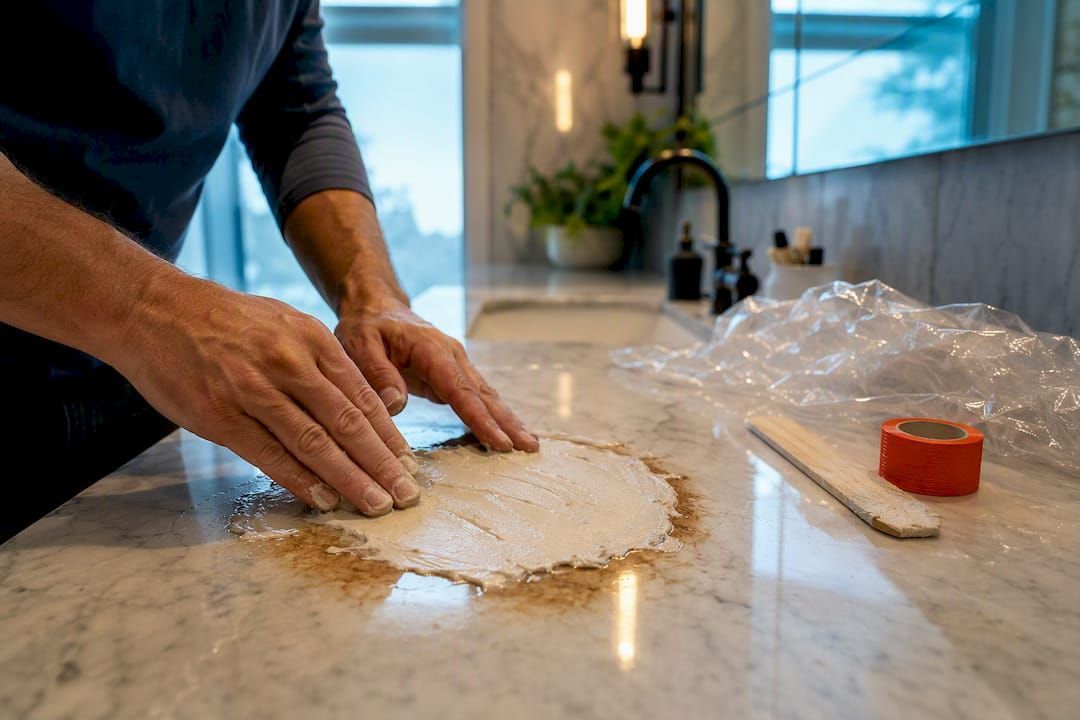
Table of Contents
- How to Clean Marble Rust: What's Actually Causing the Stain
- What Should You Try Before Reaching for Chemicals?
- How Do You Poultice a Rust Stain Out of Marble?
- What Chemicals Actually Remove Rust From Marble Safely?
- When Is Rust in Marble Permanent?
- How Do You Stop Rust From Coming Back on Marble?
- Where Does Oceancarestore Fit Into This Process?
- A Stone-Care Perspective on Rust Removal Patience
- Where to Buy Stone-Safe Cleaners and Sealers for This Job
- Sources
How to Clean Marble Rust: What's Actually Causing the Stain
Rust on marble almost never comes from the stone itself. Marble doesn't contain the iron content needed to rust on its own, so the discoloration is coming from an outside source that's leaching iron onto or into the surface.
The usual suspects include:
- Metal flashing, fasteners, or rebar embedded near the stone that's corroding and bleeding through
- Old pipes, fixtures, or planters that sit directly on the marble and leave a ring
- Iron-rich groundwater or irrigation runoff seeping in from below or the side
- Steel wool, wire brushes, or metal tools used during a previous cleaning attempt
Figuring out whether the rust is surface level or buried deep changes your whole approach. Surface stains tend to look orange or reddish brown, sit right where the metal source touched the stone, and lighten noticeably after the first cleaning pass. Deep stains run darker, almost rust brown to black, spread in an uneven halo, and barely budge after an initial wipe down. If you can trace the stain back to a specific rusting object, remove or replace that object before you start any treatment. Otherwise you're just cleaning the same spot again in six months.
What Should You Try Before Reaching for Chemicals?
Before mixing anything, run through these low-risk steps. They cost you nothing but time, and skipping them is how DIYers turn a manageable stain into a permanent one.
- Clean the area with a pH-neutral stone cleaner. Wipe down the stained section and the surrounding stone, then dry it completely with a soft cloth. A pH-neutral tile and stone cleaner won't strip any sealer or open the pores further, which keeps your baseline honest before you judge how bad the stain really is.
- Test an inconspicuous spot first. Pick a hidden corner or an offcut of the same stone, apply whatever product or poultice you're considering, and watch it for the full recommended dwell time. Take a photo before and after. This step matters most on polished marble, where even a mild reducing agent can leave micro-etching you won't notice until the light hits it wrong.
- Avoid vinegar, lemon juice, and off-the-shelf rust removers. Trade professionals are blunt about this: household acidic cleaners and metal-targeted rust products will damage calcium-carbonate stone on contact, no matter how diluted you make them.
- Skip the abrasive pads and metal scrapers. Steel wool and wire brushes don't lift rust off marble. They scratch the surface and can actually push iron particles deeper into the pores, which is the opposite of what you want.
If the stain lightens noticeably after a gentle pH-neutral clean, you're likely dealing with a surface deposit that will respond well to poulticing. If it doesn't move at all, plan on a poultice from the start and set your expectations for multiple rounds.
How Do You Poultice a Rust Stain Out of Marble?
Poulticing works on a simple principle: you build a paste that draws liquid, and therefore dissolved iron, out of the stone as it dries. Done correctly, it's the safest method available for marble, and it's the approach both GSA's historic preservation guidance and stone trade professionals recommend as the standard fix.
What you'll need:
- An absorbent powder base such as diatomaceous earth, kaolin clay, or talc, or a commercial rust-remover poultice powder made for natural stone
- A plastic mixing container and a plastic or wooden spatula (never metal)
- Plastic wrap and painter's tape
- Distilled or mineral water, since tap water can carry its own dissolved minerals that muddy the result
- A pH-neutral stone cleaner for before and after
Mixing the poultice. Combine the absorbent powder with water, or with a commercial rust-remover concentrate if you're using one, until you get a consistency close to peanut butter. Too thin and it slides off the wall or slumps flat on a countertop. Too thick and it dries before it can pull anything out of the stone.
Applying it. Spread the paste over the stain at roughly a quarter inch thick, extending it at least half an inch to a full inch beyond the visible edge of the discoloration. That margin matters more than it looks like it should. Stop right at the stain's border and you risk pushing rust sideways into clean stone instead of pulling it up and out.
Covering it. Lay plastic wrap loosely over the poultice and tape down the edges so it seals against air on all sides. Then poke a few small holes through the plastic with a toothpick. This isn't optional. Sealing it completely traps moisture and stops the wicking action that draws the iron up; poking holes lets evaporation happen slowly and pulls the stain into the poultice instead of leaving it exactly where it started.
Waiting it out. Commercial rust-remover poultices typically need 24 to 48 hours to dry fully. Some reducing-agent formulas work faster, but don't rush the process by peeling back the plastic to check on progress every few hours. Every time you break the seal, you interrupt the evaporation cycle that's doing the actual work.
Removing and inspecting. Once the poultice has dried completely and turned hard and crumbly, scrape it off with the plastic or wooden spatula. Never use anything metal here, since a metal edge can scratch polished marble in a single pass. Rinse the area with distilled water and let it dry fully before you judge the result. Wet stone always looks lighter than dry stone, so give it a few hours before deciding whether the treatment worked.
Repeating if needed. Deep or older stains often need two or three rounds of poulticing before they lift completely. That's normal, not a sign you did something wrong. Each application typically pulls the stain a little lighter, so track your progress with photos rather than judging success or failure off a single attempt.
Pro Tip: Mark the poultice edges with painter's tape before you spread the paste. It keeps your margin consistent and stops you from accidentally feathering the poultice too thin at the borders, which is where slow, uneven drying tends to happen.
What Chemicals Actually Remove Rust From Marble Safely?
Rust removal comes down to chemistry, not scrubbing power. Reducing agents and chelators work by converting insoluble iron oxide into a form that dissolves in water, so the poultice can carry it away as it dries. Acids do something completely different: they attack the calcium carbonate in marble directly, which is why lemon juice or a hardware-store rust remover leaves a dull, etched patch even if the rust itself disappears.
A peer-reviewed conservation study tested a poultice built from cysteine and sodium dithionite in a Laponite clay base, and found it removed iron discoloration from weathered marble quickly and with low toxicity. The same study noted slight etching on high-gloss polished samples, which is the tradeoff to weigh before treating a prized, mirror-finish surface. GSA's own technical procedure lists oxalic acid solutions and sodium hydrosulfite as options too, but flags them with the same etching caution and recommends flushing with sodium citrate afterward in some cases.
Before you buy any product, check the label for a few specific things:
- A stated claim of being safe for calcium carbonate or natural stone, not just "safe for tile"
- A pH-neutral or near-neutral formulation, rather than a generic "rust remover" aimed at concrete or metal
- Clear instructions on dwell time and dilution, since overexposure is what causes etching even with gentler chemistries
For most homeowners, pairing a commercial rust-remover powder with a poultice base beats applying a liquid product straight onto the stain. The poultice controls how long the chemistry sits in contact with the marble, and it pulls the dissolved iron away instead of leaving it to reabsorb as the liquid evaporates on its own.
When Is Rust in Marble Permanent?
Some rust stains just won't come out, and it's worth knowing the warning signs before you sink a weekend into repeated poultice rounds. Restoration professionals note that interior iron deposits sometimes resist every poulticing attempt, particularly in light-colored marbles like Carrara, where even faint discoloration reads as a major flaw.
Watch for these signals that you're past the point of DIY:
- The stain stays dark brown or black after two or three full poultice cycles with no visible lightening
- The discoloration seems to run through the stone rather than sitting on top of it, visible from multiple angles or even on the underside of a thin slab
- You're working with a high-polish finish where the client or homeowner cares more about the mirror shine than about the stain, since repeated poulticing risks the etching noted even in the conservation-grade cysteine and dithionite formula
- You're considering a stronger reducing agent like sodium hydrosulfite, which carries handling warnings and works best in the hands of someone trained to manage it safely
At that point, a stone restoration professional has tools you don't: diamond polishing equipment to correct etching, access to stronger regulated chemistries, and the experience to know when replacement is genuinely cheaper than continued treatment.
How Do You Stop Rust From Coming Back on Marble?
Removing the stain solves half the problem. The other half is making sure the same rust doesn't reappear in the same spot six months later, which means dealing with whatever put the iron there in the first place.
Start with the source:
- Replace or seal any corroding metal fixtures, flashing, or fasteners that sit against the stone
- Improve drainage around outdoor marble features so water carrying dissolved iron doesn't pool and soak in
- Swap metal planters, furniture feet, or decor for non-ferrous materials wherever they touch marble directly
Once the surface is clean and dry, reseal it. A penetrating sealer formulated for calcium carbonate stone fills the pores that would otherwise soak up iron-laden water again. Marble.com's own poultice guide recommends resealing as a standard final step once the rust has been fully removed, and it's not a step worth skipping just because the stain is gone.
For routine upkeep, stick to a pH-neutral cleaner and check high-risk spots, drains, outdoor edges, anywhere metal sits nearby, every few months rather than waiting for a new stain to show up.
Where Does Oceancarestore Fit Into This Process?
Oceancarestore builds its cleaning and sealing products specifically around natural stone chemistry, which means every formula avoids the acids that cause the etching problem this whole guide has been warning you about. That's the same principle behind every poultice method above: protect the calcium carbonate while still getting the stain out.
Once your rust treatment is done, the workflow that keeps marble looking right comes down to two products. A pH-neutral tile and stone cleaner handles the pre-poultice clean and ongoing maintenance without stripping anything or opening the stone's pores further. A penetrating sealer built for calcium carbonate stone locks the surface down afterward, so the next iron-laden splash from a fixture or planter has somewhere to run off instead of soaking in.
Both are plant-based and low VOC, which matters if the marble in question is a kitchen counter or a shower you touch every day.
A Stone-Care Perspective on Rust Removal Patience
The single biggest mistake I see with marble rust removal isn't chemistry. It's timing. Homeowners mix a poultice correctly, apply it correctly, and then peel back the plastic wrap after six hours because the waiting feels unproductive. That interrupts the exact evaporation process that pulls the iron out, and it's the fastest way to turn one clean treatment into three messy ones.
Conservative chemistry beats aggressive chemistry here every time. A slower reducing-agent poultice that takes two rounds over four days will almost always cost you less, in stone and in money, than an acidic quick fix that etches the surface on the first try. Test a hidden spot, document what you see, and give the poultice the full dwell time it's asking for. The stone will tell you if it worked once it's actually dry.
Where to Buy Stone-Safe Cleaners and Sealers for This Job
If you're heading into a poultice weekend, you don't need a cabinet full of random products. You need three things: a pH-neutral cleaner for before and after, a penetrating sealer to lock the stone once the stain is gone, and a plastic applicator or spatula so you're never tempted to reach for a metal scraper.
Oceancarestore's pH-neutral tile and stone cleaner is the cleaner we'd reach for at every stage of this process, from the initial test patch through routine upkeep months later. Pair it with the high-performance penetrating sealer once your rust treatment succeeds, and you've closed the loop on the whole problem instead of just masking it for a season. Both are plant-based, biodegradable, and formulated specifically for calcium carbonate stone, so there's no acid risk hiding in the bottle. Check the product pages for current sizing and pricing, and order what you need before you start mixing your poultice, so you're not left mid-treatment with a stain drying out and no sealer on hand to finish the job.
Sources

