
Homeowners: Clean Granite Countertops Safely with pH Neutral Care
The safest daily method is warm water with a drop of mild dish soap or a pH-neutral stone cleaner, applied with a microfiber cloth and dried right away. Skip vinegar, bleach, and ammonia entirely, since they eat away at the sealant over time. If you're worried about radiation from natural stone, don't be. Countertop-grade granite emits negligible amounts and poses no real risk in a home.
TL;DR:
- Using warm water with mild dish soap or a pH-neutral cleaner is safest for daily granite countertop maintenance, avoiding acids and ammonia.
- Avoid acidic products, abrasives, and citrus-scented wipes, as they can etch or degrade the stone's sealant, leading to permanent damage.
- Oil and water stains require different treatments, with poultices for deep stains and quick cleaning for fresh spills to prevent long-term damage.
- Test the seal's effectiveness regularly with water and oil bead tests; reseal when the water or oil soak in within a few minutes.
- Deep cleaning should be done annually after testing the seal, and hot pans should always be used with trivets to prevent sealant degradation.
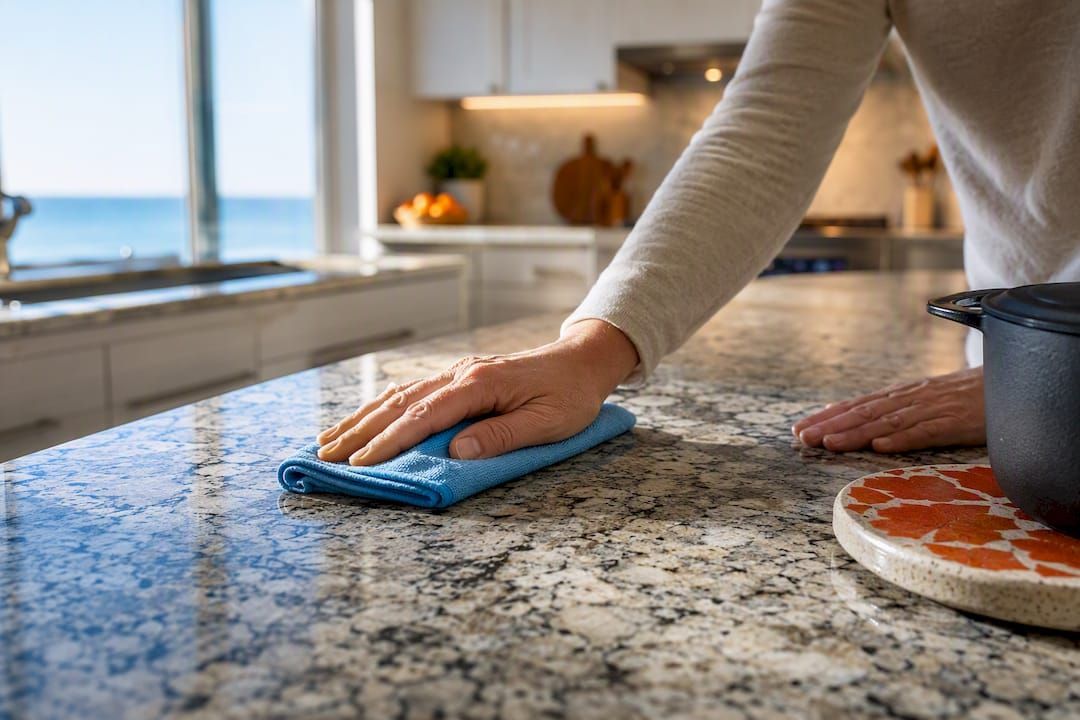
Table of Contents
- What's the Safest Way to Clean Granite Countertops Every Day?
- Which Cleaners Should You Never Use on Granite?
- How Do You Remove Stains From Granite Without Damaging It?
- How Do You Know If Your Granite Countertop Needs Resealing?
- How Do You Disinfect Granite Without Ruining the Seal?
- Why Oceancarestore Recommends pH-Neutral Formulas for Granite
- Which Products Are Actually Formulated for Granite Care?
- Is It an Etch Mark or a Stain? Here's How to Tell
- How Does Hard Water Affect Granite, and What Should You Do About It?
- What's the Right Way to Deep Clean Granite Once a Year?
- Can Heat Damage Granite Countertops?
- Author Perspective: Small Habits Do Most of the Work
- Get the Right Products for Safe, Long-Lasting Granite Care
- Sources
What's the Safest Way to Clean Granite Countertops Every Day?
You don't need a cabinet full of specialty products to keep granite looking sharp. A soft sponge, a couple of microfiber cloths, a spray bottle, and either mild dish soap or a dedicated pH-neutral cleaner will cover 95% of your cleaning needs.
Mix about one teaspoon of mild dish soap into a pint of warm water in your spray bottle, or follow the label dilution if you're using a pH-neutral stone cleaner. Spray a light mist across the surface, then wipe in small circular motions with a soft sponge. Follow immediately with a barely damp cloth to lift any soap residue, then dry with a clean microfiber towel. Skipping that final dry step is how streaks and dull spots build up over weeks.
- Microfiber cloths (at least two: one for wiping, one for drying)
- Soft, non-abrasive sponge
- Spray bottle for diluted cleaner
- Mild dish soap or pH-neutral stone cleaner
Dish soap works fine for quick wipe downs, but if you're dealing with a greasy film near the stove, hard water spots, or you want to maintain a polished finish without dulling it, a cleaner formulated specifically for stone does a better job. Specialists note that dedicated pH-neutral cleaners outperform repeated dish soap use because they lift film without leaving behind the waxy buildup soap can create.
Pro Tip: Keep a spray bottle of diluted pH-neutral cleaner right under the sink. If it's not within arm's reach, you'll reach for whatever's on the counter, and that's usually the wrong thing.
Which Cleaners Should You Never Use on Granite?
Granite looks tough, but its sealant is not. Here's what to keep away from it, ranked by how fast it does damage:
Reading the label matters more than trusting the marketing. Products branded "all purpose" often contain acids or ammonia that granite simply can't tolerate.
How Do You Remove Stains From Granite Without Damaging It?
- Vinegar, lemon, and other acids. These etch the surface and strip the sealant on contact, even in small amounts.
- Bleach and ammonia. Both break down the finish over repeated exposure, leaving the stone more vulnerable to staining.
- Glass cleaners like Windex. Most contain ammonia or acidic compounds that quietly wear down sealant with every use.
- Abrasive pads, steel wool, and powdered scrubs. These physically scratch the stone, and those scratches trap dirt permanently.
- Citrus-scented disinfectant wipes. Convenient, but many contain citric acid that erodes sealant with regular use.
Start by figuring out what kind of stain you're dealing with, because oil and water-based stains need different treatments entirely.
Oil-based stains (cooking grease, butter, salad dressing) tend to darken the stone and spread slightly at the edges. Wipe the area with a cloth dampened in 70% isopropyl alcohol and a little mild soap to break down the grease. If the stain lingers, move to a poultice.
Organic and water-based stains (coffee, wine, fruit juice) usually respond well to a paste of baking soda and hydrogen peroxide, since that combination lifts many organic stains without needing acid.
To apply a poultice:
- Mix baking soda with hydrogen peroxide (or water, for oil-based stains) into a thick paste.
- Spread the paste over the stain, about a quarter inch thick.
- Cover with plastic wrap and tape the edges down.
- Let it sit for at least 24 hours undisturbed.
- Remove the dried paste, rinse with water, and dry thoroughly.
Test any treatment on a hidden corner first, and never repeat acid-based treatments hoping for a better result, since that's how you end up with a dull patch that's worse than the original stain. If a stain has been there for weeks or you can't identify what caused it, call a stone restoration professional before you experiment further.
Pro Tip: Fresh wine or coffee spills come up in minutes with a quick wipe. Wait a day, and you're looking at a 24-hour poultice project. Speed matters more than the product you use.
How Do You Know If Your Granite Countertop Needs Resealing?
Two simple tests tell you everything you need to know. For the water test, pour a small puddle of water on the surface and watch it. If it beads up and sits there for 15 to 20 minutes, your seal is holding. If it soaks in and darkens the stone within a few minutes, it's time to reseal. The oil test works the same way with a few drops of cooking oil, and it's a slightly more sensitive indicator since oil penetrates sealed granite faster than water does.
How often you need to repeat this depends on the stone itself. Reseal frequency typically ranges from one to five years, depending on how porous your particular slab is, the finish (honed granite absorbs more than polished), and how often you're using harsh cleaners that wear the sealant down early.
When it's time to reseal:
- Clean the surface thoroughly and let it dry for a full 24 hours.
- Apply the sealer per the manufacturer's label, usually in thin, even coats.
- Wipe off all excess sealer before it dries, using a clean cloth.
- Let the surface cure for 24 to 48 hours before putting anything on it.
The biggest mistake homeowners make is leaving excess sealer to dry instead of buffing it off, which creates a milky haze that's a pain to correct. The second biggest mistake is resealing on a schedule instead of testing first. Some dense or factory-resin-treated granites barely absorb sealer at all, and applying more can actually cause streaking instead of protection.
How Do You Disinfect Granite Without Ruining the Seal?
For everyday messes, soap and water handle it. When you actually need to disinfect, spray 70% isopropyl alcohol on the surface, let it sit for three to five minutes, then wipe and dry. This kills germs effectively without stripping the sealant the way bleach or ammonia would.
Routine bleach use is discouraged because repeated exposure degrades the seal over months, not days, so the damage sneaks up on you. If you're dealing with something like raw meat juice and want a stronger option occasionally, a heavily diluted bleach solution, wiped off fast and followed by a rinse, is an acceptable last resort rather than a daily habit.
On the radiation question that comes up constantly: granite does contain trace natural radioisotopes, but countertop-grade granite emits levels so low they're not considered a household health concern.
Why Oceancarestore Recommends pH-Neutral Formulas for Granite
Granite care comes down to one principle: whatever touches the stone shouldn't fight the sealant protecting it. Acidic and harsh alkaline cleaners break that seal down molecule by molecule, which is why Oceancarestore built its formulas around pH-neutral, plant-based ingredients instead of the citrus-scented or ammonia-based cleaners lining most store shelves.
Low-VOC, biodegradable formulas clean effectively without leaving behind the residue or acidity that shortens a seal's lifespan. For daily maintenance, the pH Neutral Tile & Stone Cleaner Concentrate dilutes economically for regular wipe downs. Always test a small area first and follow the label's dilution ratio exactly, since more concentrated isn't better on natural stone.
Which Products Are Actually Formulated for Granite Care?
Not every "stone cleaner" on a shelf is built for granite specifically, and that distinction matters more than most labels let on. Granite needs a cleaner that's pH-neutral (typically in the 7 to 8 range), free of dyes and heavy fragrance additives, and biodegradable enough that residue doesn't build up on the sealant over repeated use.
Look for three things on any label before buying: a stated pH-neutral formula, explicit mention of "safe for natural stone" or "safe for granite," and no citrus, vinegar, or bleach listed in the ingredients. Products marketed generically as "kitchen cleaner" or "multi-surface spray" frequently fail all three tests, even when the packaging shows a granite countertop in the photo.
For sealing specifically, a dedicated stone and grout sealer formulated for natural stone porosity gives more predictable results than an all-purpose sealant pulled off a hardware store shelf. Penetrating sealers made for granite account for the stone's density and won't sit on the surface creating the haze problem mentioned earlier. If you've already run into cloudiness or uneven coverage from a previous sealing job, it helps to understand the common problems that show up with stone sealers before you try to fix it yourself.

Is It an Etch Mark or a Stain? Here's How to Tell
This distinction trips up more homeowners than almost anything else in granite care, and treating one as the other makes the problem worse.
A stain sits on top of or soaks slightly into the stone, and it usually has color: a brown ring from coffee, a purple tinge from wine, a dark patch from oil. Stains respond to the poultice methods covered earlier, because you're pulling the offending substance back out of the pores.
An etch mark is physical damage, not discoloration. It's a dull, often ring-shaped spot where an acid (citrus juice, vinegar, a tomato-based sauce) actually dissolved a microscopic layer of the stone's surface or sealant. Etch marks don't have color of their own. They just look flat and hazy compared to the surrounding polish, and running a poultice on them does nothing because there's nothing to pull out.
If it's an etch, your only real fixes are a light polishing compound made for stone, or, for deeper etching, a professional fabricator who can hone and re-polish that section. Trying to "clean" an etch mark harder just wastes product and time.
How Does Hard Water Affect Granite, and What Should You Do About It?
Hard water leaves behind mineral deposits, mostly calcium and magnesium, that build up as a chalky film wherever water sits and evaporates on the surface. Around a kitchen faucet or under a frequently filled dish rack, this shows up as cloudy spots that don't wipe away with a quick pass of a cloth.
The fix isn't a stronger cleaner. It's catching moisture before it evaporates in place. Wipe down wet areas after use rather than letting puddles dry on their own, and if you're in a region with notably hard water, a squeegee pass near the sink after dishes takes fifteen seconds and prevents most buildup entirely.
For deposits that have already formed, a pH-neutral cleaner with a slightly longer dwell time (spray it on, wait two to three minutes, then wipe) usually breaks up mineral film without the abrasive scrubbing that scratches the stone. Avoid the instinct to reach for a descaling product built for coffee makers or showerheads. Those are frequently acidic and will etch granite exactly like vinegar would.
What's the Right Way to Deep Clean Granite Once a Year?
Beyond daily wipe downs, granite benefits from one thorough deep clean annually, timed around when you run your water and oil tests to check the seal anyway.
Start by clearing the entire counter and doing a full wipe with your regular pH-neutral cleaner to lift everyday grime. Next, run the water and oil bead tests from earlier in a few different spots, since sealant wears unevenly across a counter depending on traffic and sun exposure. If the seal passes, move to a deeper clean: a slightly longer dwell time with your stone cleaner, focused attention on edges and around the sink where grime accumulates, and a final alcohol wipe if you want a disinfecting pass.
If the seal fails either test, this is the moment to reseal rather than waiting for a visible stain to force the issue. Clean thoroughly, dry for a full 24 hours, apply sealer, wipe excess, and let it cure. Finish the year's maintenance by checking your cutting boards and trivets for wear, since scratched or thin cutting boards let more knife pressure transfer straight to the stone.
Can Heat Damage Granite Countertops?
Granite handles heat better than almost any other kitchen surface, but "better than others" isn't the same as "immune." Sudden, extreme temperature shifts, like moving a pot straight from a 450-degree oven onto a cold counter, can create micro-stress in the stone over time, and repeated direct contact with hot pans can occasionally scorch or discolor the sealant layer even when the granite itself is fine underneath.
The bigger risk isn't the heat itself. It's what heat does to sealant. Direct, repeated hot-pan contact in the same spot degrades the seal faster than almost any cleaning chemical would, leaving that section more porous and stain-prone months before the rest of the counter.
Use trivets or heat pads under anything straight off the stove or oven, and give pans a few seconds to cool before setting them down if a trivet isn't handy. It's a small habit that adds years to your seal's life.
Author Perspective: Small Habits Do Most of the Work
The homeowners with the best-looking granite years later aren't using fancy products. They're consistent about three things: wiping spills the moment they happen, always using a cutting board, and keeping a trivet within reach of the stove. I see the same mistake constantly: someone sets a hot pan down "just for a second" on bare stone, and that second becomes a habit that wears the seal thin exactly where it matters most.
Get the Right Products for Safe, Long-Lasting Granite Care
You've got the techniques down: pH-neutral cleaning, careful stain removal, proper sealing. The missing piece for a lot of homeowners is simply having the right formula on hand instead of grabbing whatever's under the sink. Oceancarestore builds every cleaner and sealer around that exact gap, plant-based and low-VOC where most stone products lean on harsh chemistry to get results fast.
For daily maintenance, the pH Neutral Tile & Stone Cleaner handles everyday wipe downs without touching your sealant. When your water and oil tests tell you it's time to reseal, the Stone & Grout Sealers collection is formulated specifically for natural stone porosity, with clear label directions on dilution and the 24 to 48 hour cure window. Read the label fully before your first application, test a small section, and you'll get consistent results without the guesswork that leads to haze or streaking. Browse the product pages now and pick the combination that matches your counter's actual needs.
Sources
This guide draws on granite care guidance from BobVila, The Home Depot, The Kitchn, The Spruce, and Dynamic Stone Tools. When you're unsure about a specific stain, sealant issue, or chemical product, check the manufacturer's label first, or consult a stone fabricator, resources like Sussex Drain Ltd's guide to chemical safety cover similar caution around harsh household chemicals.

