
Routine Pool Maintenance: Safety, Longevity, and Cost Savings
Routine pool maintenance prevents recreational water illnesses, preserves surfaces and equipment, and cuts long-term operating costs. That's the short version. The longer version is what this guide covers: the chemical targets, the inspection triggers, the scheduling decisions, and the surface-care choices that separate a pool that runs cleanly for decades from one that demands emergency repairs every season.
Three pillars hold every well-run pool together:
- Circulation: Move water continuously so sanitizers distribute evenly and dead zones can't form.
- Cleaning: Skim, brush, and vacuum on a consistent schedule to remove the organic load that drives up chemical demand.
- Chemistry: Test and adjust pH, free chlorine, alkalinity, and calcium hardness regularly to keep water safe and surfaces intact.
One immediate action: test your water this week. If you haven't logged a reading in the last seven days, start there.

Key Takeaways
Routine pool maintenance prevents illness, extends equipment and surface life, and costs far less than emergency recovery — the triad of circulation, cleaning, and chemistry is the framework that makes it work.
| Point | Details |
|---|---|
| Chemical targets are non-negotiable | Keep pH at 7.2–7.6 and free chlorine at 1–3 ppm to control pathogens and protect surfaces. |
| Test and log consistently | Residential pools need 1–2 tests per week; public pools need at least twice daily, hourly during heavy use. |
| Filter pressure is your early warning | Backwash or clean when pressure rises 10 PSI above baseline to protect the pump and maintain flow. |
| Routine care beats emergency recovery | DIY maintenance runs roughly $300–$500 per year; a single algae recovery or pump replacement can cost multiples of that. |
| Oceancarestore for surface care | pH-neutral cleaners, calcium releasers, and penetrating sealers protect pool tile and stone without acid damage or harsh VOCs. |
Table of Contents
- How does routine maintenance protect swimmers from illness?
- What are the three core components of pool maintenance?
- What does a practical pool maintenance schedule look like?
- How do you inspect and protect pumps, filters, and pool finishes?
- Does routine maintenance actually save money?
- What recordkeeping do public pool operators need?
- What mistakes and warning signs should you watch for?
- Why do eco-friendly cleaners matter for pool tile and stone?
- Oceancarestore products that support your routine
- Why Oceancarestore puts surface care at the center of routine maintenance
- Sources
How does routine maintenance protect swimmers from illness?
Waterborne pathogens don't announce themselves. A pool can look clear and still carry Cryptosporidium , E. coli , or Pseudomonas at levels that cause recreational water illnesses (RWIs) ranging from skin rashes to gastrointestinal infections. The CDC's Healthy Swimming prevention guidance identifies consistent pH and disinfectant control as the primary defense against RWIs, with target ranges of pH 7.2–7.6 and free chlorine 1–3 ppm.
Why those numbers? Chlorine's killing efficiency drops sharply above pH 7.8. At pH 8.0, hypochlorous acid (the active sanitizing form) makes up only about 20% of total chlorine. Keep pH in range and the same chlorine dose does far more work.
Chemical targets every operator should post
For public pools, the CDC's operating toolkit for public pools, hot tubs, and splash pads recommends testing pH and disinfectant levels at least twice per day, and hourly during periods of heavy bather load. That cadence isn't bureaucratic caution; it reflects how fast chemistry shifts when 50 people jump in on a hot afternoon.
Fecal-accident response: the steps that matter
- Clear the pool immediately and keep all bathers out.
- Remove visible material with a net; do not vacuum (this spreads contamination).
- Raise free chlorine to the level specified in your jurisdiction's fecal-accident protocol (typically 2 ppm for formed stool, 20 ppm for diarrheal incidents).
- Maintain the elevated chlorine level for the required contact time before reopening.
- Log the incident, the response actions, and the time the pool was cleared and reopened.
Statistic callout: The CDC links the majority of pool-associated disease outbreaks to failures in disinfection and pH control, not to contamination events alone. Consistent chemistry is the line of defense.
What are the three core components of pool maintenance?
The maintenance triad described by HomeInDepth — circulation, cleaning, and chemistry — works as a system. Neglect one and the others compensate at higher cost. Let circulation slip and sanitizer distributes unevenly, creating dead zones where biofilm builds. Let cleaning slide and organic load spikes, burning through chlorine faster. Let chemistry drift and you're fighting algae and equipment damage simultaneously.
Circulation
Run your pump for several hours per day, ideally during daylight when UV degrades chlorine fastest. The goal is at least one full water turnover per day for residential pools. Clean skimmer and pump baskets regularly; a clogged basket cuts flow rate and strains the motor.
Pro Tip: Variable-speed pumps run longer at lower RPM for a fraction of the energy cost of a single-speed pump at full throttle. Running a variable-speed pump 10–12 hours at medium speed typically uses less electricity than running a single-speed pump 6–8 hours at full speed, while delivering better filtration and chemical distribution. Lowe's pool maintenance guidance highlights this as one of the highest-return equipment upgrades for residential pools.
Cleaning
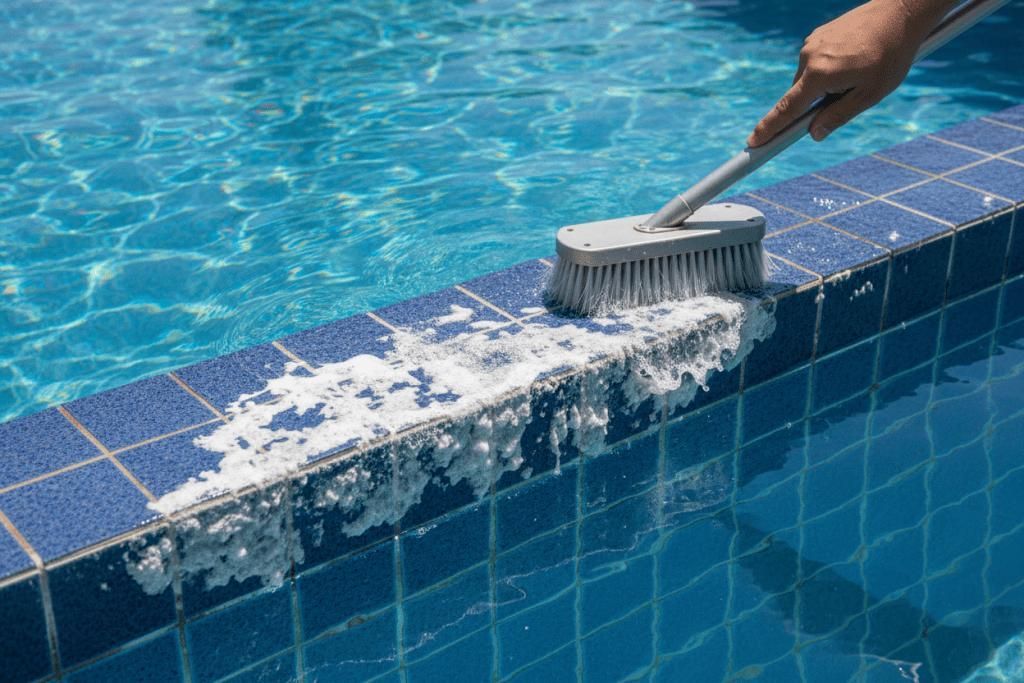
Dead spots behind ladders, in corners, and on steps collect biofilm that automatic cleaners routinely miss. Manual brushing once a week breaks up that biofilm before it anchors. Skim the surface 2–3 times per week, vacuum weekly, and keep algae from gaining a foothold by never skipping the brush.
Chemistry: testing and shock
Test residential pools regularly each week. Use a reliable test kit (DPD drop kits or digital photometers beat test strips for accuracy). Shock weekly during summer or after heavy use, and after any fecal incident. Cyanuric acid (stabilizer) should sit between 30–50 ppm for outdoor pools; above 80 ppm it suppresses chlorine activity enough to require a partial drain.
Weekly and monthly checklist:
- Daily: Check water level, skim surface, inspect pump operation.
- Weekly: Test chemistry, brush walls and floor, vacuum, clean skimmer baskets, check filter pressure.
- Monthly: Inspect pump seals and motor, backwash or clean filter, check heater and automation sensors, inspect pool surface for staining or scaling.
What does a practical pool maintenance schedule look like?
Mission Pools' residential maintenance guide frames it plainly: weekly skimming, brushing, and testing, plus monthly equipment checks, form the backbone of routine care that prevents small problems from becoming expensive repairs.
| Frequency | Task | Typically Performed By |
|---|---|---|
| Daily | Skim surface, check pump operation, verify water level | Owner |
| 2–3x per week | Clean skimmer and pump baskets | Owner |
| Weekly | Test and adjust chemistry, brush walls/floor, vacuum, check filter pressure | Owner or pro |
| Monthly | Backwash/clean filter, inspect pump/motor/seals, check heater, inspect surface | Owner or pro |
| Seasonally | Open/close procedures, inspect plumbing, replace worn O-rings, drain and refill if TDS is high | Pro recommended |
When to call a professional
DIY works well for daily and weekly tasks when you're consistent. Hire a professional service when:
- Chemistry swings repeatedly despite correct dosing (points to a circulation or filtration problem).
- Filter pressure spikes faster than usual between cleanings.
- You're managing a public or semi-public facility where MAHC and CDC compliance requires documented operator training.
- A heat wave, heavy storm, or unusually high bather load has pushed chemistry out of range and you're not sure why.
One missed week compounds quickly. As Lone Star Pool Cleaning notes, a single skipped service often triggers algae growth, elevated chemical demand, and filter strain simultaneously — three problems that cost more to fix than the service would have.
How do you inspect and protect pumps, filters, and pool finishes?
Clear water can be deceptive. Invisible chemical imbalances and equipment strain build up unless you measure and log them regularly, as PoolReady's maintenance overview points out. Monthly physical inspections catch what chemistry tests miss.
Monthly inspection checklist:
- Pump and motor: Listen for cavitation (a grinding or rattling noise), check for vibration, inspect shaft seal for drips.
- Filter pressure gauge: Record baseline pressure after a clean backwash. Backwash or clean the filter when pressure rises 10 PSI above that baseline, per SwimmingPool.com's pool care guidance.
- Heater: Check for scale buildup on heat exchanger; verify ignition and thermostat function.
- Salt cell (if applicable): Inspect for calcium deposits; clean per manufacturer schedule.
- Automation sensors and flow switches: Confirm readings match manual tests.
- Skimmer weirs and drain covers: Replace cracked or missing covers immediately — this is a safety requirement, not a cosmetic one.
- Pool surface: Look for pitting, staining, or tile separation, which signal chemistry or sealer failure.
Statistic callout: A filter running 10 PSI above baseline is working significantly harder than designed, which shortens media life and reduces filtration efficiency. Catching that early costs a backwash cycle; ignoring it costs a filter replacement.
Small preventive replacements, such as O-rings, feed tubing on chemical dosers, and skimmer gaskets, typically cost a few dollars each. The same failure left unaddressed can force a pump replacement or a plumbing repair that runs into hundreds of dollars. Balanced chemistry plays a parallel role: water that's too acidic leaches minerals from grout and plaster, producing pitting and tile failure over time. Water that's too hard deposits scale on heater elements and pipe walls. Staying in range protects both surfaces and mechanical components.
Does routine maintenance actually save money?
The financial case for consistent pool upkeep is straightforward. Routine care costs less than reactive repair, and the gap is wide.
- DIY maintenance: Roughly $300–$500 per year in chemicals, test supplies, and minor consumables for a typical residential pool.
- Monthly professional service: Generally $80–$150 per visit, or $960–$1,800 per year, covering chemistry, cleaning, and basic equipment checks.
- Weekly professional service: Typically $150–$250 per month, or $1,800–$3,000 per year, with more frequent equipment monitoring.
Compare those figures against a single algae recovery (draining, scrubbing, refilling, and rebalancing can run $400–$800 for a severe bloom) or a pump replacement ($500–$1,500 parts and labor). A cracked heat exchanger from scale buildup can exceed $1,000. Replastering a pool damaged by chronic low pH runs $5,000–$15,000 depending on pool size.
The California Pool Association notes that consistent maintenance also reduces the risk of compliance fines and forced closures for commercial facilities, which carry costs well beyond the repair itself. Professional technicians also catch patterns that owners miss, such as a slow pressure rise that signals a failing filter before it fails completely.
Longer equipment life, fewer emergency calls, better resale value, and uninterrupted use: the ROI on routine care is not subtle.
What recordkeeping do public pool operators need?
Facility managers operating public pools carry a documentation obligation that goes beyond what a residential owner needs. The CDC's Model Aquatic Health Code frames testing frequency, operator responsibilities, and recordkeeping expectations as core to reducing public-pool health risks, and many jurisdictions use MAHC as their operational reference.
What to log for every test:
- Date and time of test
- pH reading and free chlorine reading (combined chlorine if testing for chloramines)
- Corrective action taken (chemical added, type, and amount)
- Operator name or ID
- Bather load at time of test (for public pools)
- Any equipment anomalies observed
For fecal incidents: log the time discovered, bather evacuation time, response actions taken, chemical levels before and after treatment, and pool reopening time.
Operator training: The CPO (Certified Pool Operator) credential, administered through the Pool & Hot Tub Alliance, is the recognized standard for public pool operators in the United States. Many jurisdictions require it by law. Even where it isn't mandatory, CPO training gives operators the systematic framework that makes compliance straightforward rather than reactive.
A single log entry for one test might look like: "June 14, 9:05 AM — pH 7.4, free Cl 1.8 ppm, added 12 oz sodium bicarbonate to raise alkalinity, Operator: J. Torres, bather load: 22." That level of specificity is what health inspectors look for and what protects a facility if an illness complaint arises.
What mistakes and warning signs should you watch for?
Common maintenance errors:
- Skipping regular testing and dosing by eye or by schedule alone (chemistry doesn't follow a calendar).
- Over-relying on robotic or automatic cleaners as a substitute for manual brushing, especially in corners and on steps.
- Over-shocking: repeated high-concentration shock cycles accelerate wear on seals and sensors faster than stable, consistent chemistry does.
- Ignoring a gradual filter pressure rise until the pump strains visibly.
Red flags that need immediate attention:
- Sudden free chlorine drop below 1 ppm, especially after heavy use or a storm.
- Cloudy water that doesn't clear within 24 hours of correct chemical adjustment.
- Pump cavitation noise (grinding, rattling) or air bubbles returning through return jets.
- Unexplained water level loss of more than ¼ inch per day (possible leak).
- Persistent green or black algae despite correct chlorine levels (check for dead spots and circulation issues).
Quick troubleshooting starting points:
- Cloudy water: test for combined chlorine (chloramines); if above 0.5 ppm, shock to break them down.
- Algae: check circulation dead spots, brush thoroughly, raise free chlorine, and verify stabilizer isn't suppressing chlorine activity.
- Rapid chlorine loss: check cyanuric acid level and inspect for direct sunlight exposure on uncovered pools.
- Pressure spike: backwash immediately, then investigate whether bather load, a storm, or algae growth caused the surge.
Why do eco-friendly cleaners matter for pool tile and stone?
Pool tile and natural stone around pools face a specific threat that water chemistry alone doesn't address: surface damage from improper cleaners. Acidic cleaners etch grout, leach minerals from plaster, and weaken the bond between tile and substrate over time. The damage is cumulative and often invisible until a tile pops or grout crumbles.
Non-acid, plant-based cleaners reduce this risk significantly. They remove calcium deposits, biofilm, and staining without attacking the surface chemistry of the substrate. For routine pool tile and stone surface care, a pH-neutral cleaner applied weekly handles most organic staining and mineral haze without the risk that acid-based products carry.
Step-by-step spot-cleaning for pool tile:
- Lower the water level slightly to expose the tile line if needed.
- Apply a pH-neutral tile and stone cleaner directly to the stained area.
- Let it dwell for 2–5 minutes (longer for heavy calcium deposits).
- Scrub with a non-abrasive brush or pad.
- Rinse thoroughly before water contacts the treated area.
When to apply a penetrating sealer:
Apply a penetrating sealer to porous stone and grout after cleaning and before the pool season begins, or after any resurfacing work. Sealers fill the microscopic pores that trap calcium, algae, and staining agents, making routine cleaning faster and more effective. For surface restoration guidance on when to restore versus simply clean, check the condition of existing sealer first.
Pro Tip: Before applying any cleaner or sealer to a full tile or stone surface, test it on a small, inconspicuous patch and wait 24 hours. Stone varies widely in porosity and mineral composition; a product that works perfectly on travertine may behave differently on limestone or ceramic. The patch test takes two minutes and prevents a costly mistake.
For calcium buildup that pH-neutral cleaners can't fully address, a dedicated calcium releaser formulated for pool surfaces handles the job without the acid etching risk. Recommend product categories: pH-neutral tile and stone cleaners for weekly use, calcium releasers for periodic scale removal, and penetrating sealers for annual protection.
Oceancarestore products that support your routine
Keeping pool tile and stone in good condition doesn't require harsh chemistry. Oceancarestore's pH-neutral tile and stone cleaner is formulated for weekly use on pool tile, grout, and adjacent stone without the acid etching risk that strips grout and weakens tile bonds over time. For heavier scale and calcium deposits that build up seasonally, the Intensive Stone Cleaner Concentrate delivers deeper cleaning power while staying surface-safe.
Once surfaces are clean, the High Performance Penetrating Sealer locks out the staining agents, calcium, and biofilm that make routine cleaning harder each season. All three products are plant-based, biodegradable, and low-VOC, which matters both for the people in and around the pool and for the surfaces themselves. Eco-friendly formulas aren't a compromise on performance; they're a better fit for the chemistry-sensitive environment a pool represents. Browse the full surface care range at Oceancarestore and find the right product for your tile and stone maintenance routine.
Why Oceancarestore puts surface care at the center of routine maintenance
At Oceancarestore, the focus on plant-based, low-VOC cleaning and sealing products comes from a straightforward observation: most pool surface damage is preventable. Acid-based cleaners and unbalanced water chemistry are the two leading causes of tile failure, grout leaching, and plaster pitting, and both are avoidable with the right products and habits. The guidance in this article reflects that philosophy: consistent chemistry protects water quality, and eco-friendly surface cleaners protect the finishes that make a pool worth maintaining.
Routine habits, applied consistently, outperform intensive recovery every time. Start with a water test, run your pump on schedule, and treat your tile and stone with products that won't undo the work your chemistry is doing. That combination keeps pools safe, surfaces intact, and operating costs predictable.
This article is general information, not a substitute for advice from a qualified doctor. Consult a qualified healthcare professional about your own circumstances before acting on anything here.
Sources

